
The cost of a flood risk report is essential to understand if you are purchasing, selling, developing or remortgaging a property in the UK. There has been increasing scrutiny on the flood risk element of reports by solicitors, lenders, insurance companies and planning authorities
However, it is often misunderstood that all flood risk reports are the same. This article will explain the typical cost of a flood risk report in the UK, the factors that can affect this cost and assist you in deciding which type of flood risk report would be most suitable for your needs.
How much does a flood risk report cost in the UK?
The price of an assessment of flood risk in the UK. is dependent upon what type of assessment is being undertaken, the complexity of the site under review and whether the level of assessment required is merely based on the available data (i.e., using national datasets), or if the assessing engineer is also providing their own professional judgment as to how flood risk may affect either a property transaction, insurance or planning consent.
Therefore, the costs associated with such an assessment may be anywhere from a few dozen pounds for a basic data-driven assessment to thousands of pounds for site-specific engineering assessments.
Typical flood risk report prices in the UK
Here are the most common Flood Risk Report types and prices, from lowest to highest cost.
Flood Property Report (FPR) (from £150)
A Property Flood Report (PFR) is a flood risk report that provides a clear understanding of how your home is at risk from flooding. The report will provide you with information about what risks exist, how this may impact your insurance premium and/or availability of insurance cover and also how this may affect your property value and saleability..
It can be particularly useful when a property search indicates there could be a flood risk issue, but it has not been confirmed or the level of risk is still uncertain.
Best suited for:
- Medium/high flood risk properties identified during environmental or conveyancing searches.
- Buyers who want assurance regarding their ability to obtain insurance, either in respect of premiums, excesses, etc.
- Solicitors who need to be able to defendably answer questions regarding flood risk.
- High value, complex or urgent property transactions.
What does a PFR explain?
- Is the flood risk theoretical or material?
- What are the potential implications for your insurance premium and/or availability of insurance cover?
- How do different flood sources (river, surface water, groundwater and coastal) relate to your property?
- Will flood risk negatively affect the value/saleability of your property?
Key Benefit:
A PFR bridges the gap between technical flood modeling and practical property decision making. It interprets flood exposure in relation to insurance, value and conveyancing risk and therefore reduces uncertainty, allows for better decision making and enables property transactions to occur with greater confidence.
Flood Risk Assessment (FRA) for planning (from £750)
A Flood Risk Assessment (FRA) is typically a formal planning document required for most types of development especially those in Flood Zones 2 and 3, or when the level of surface water risk is high.
Best suited for:
- Planning applications
- Change of use or new development
- Site-specific engineering analysis
Key benefit:
Meets planning policy and Local Authority requirements.
What affects the cost of a flood risk report?
The amount that you pay for your Flood Risk Report may be affected by several things:
- How close to where you live is to the area that has been designated as a flood zone (and therefore at a higher risk) will normally determine the type of analysis that is needed.
- If there have been floods in the past, it can take longer to interpret those past floods because they provide more information on which an opinion about flood risks may be based.
- You will also have to decide whether you need a summary report, an interpretative report or an advisory report. As a general rule, the interpretative or advisory reports will cost more than a summary report.
- Finally, you will have to consider what purpose you wish your report to serve. A planning/development report would likely be more detailed than a report intended solely for use in connection with a conveyance (e.g., a home purchase).
- Reports are often used to address specific issues and enhance interpretation may require additional work and therefore cost more. Examples include assessing potential impact on property values or insurance costs.
Is a more expensive flood risk report worth it?
Lower cost flood risk reports usually include raw data of flood risk along with very little information to explain how that data was determined. Although a lower cost report may help an attorney or buyer begin researching the potential flood risks associated with a property purchase, it will likely leave both attorneys and buyers with many unanswered questions about the possible flood risks they have identified as the property purchase progresses.
For property purchases, the key issue is rarely just whether flood risk exists — but whether it could affect:
- Building insurance availability
- Mortgage approval
- Property value
- Transaction timescales
Enhanced Flood Property Reports are designed to address these concerns by interpreting flood risk data in a property-specific and practical context, reducing uncertainty and delays.
Choosing the right flood risk report
To avoid unnecessary cost or risk, it is important to match the report type to your needs:
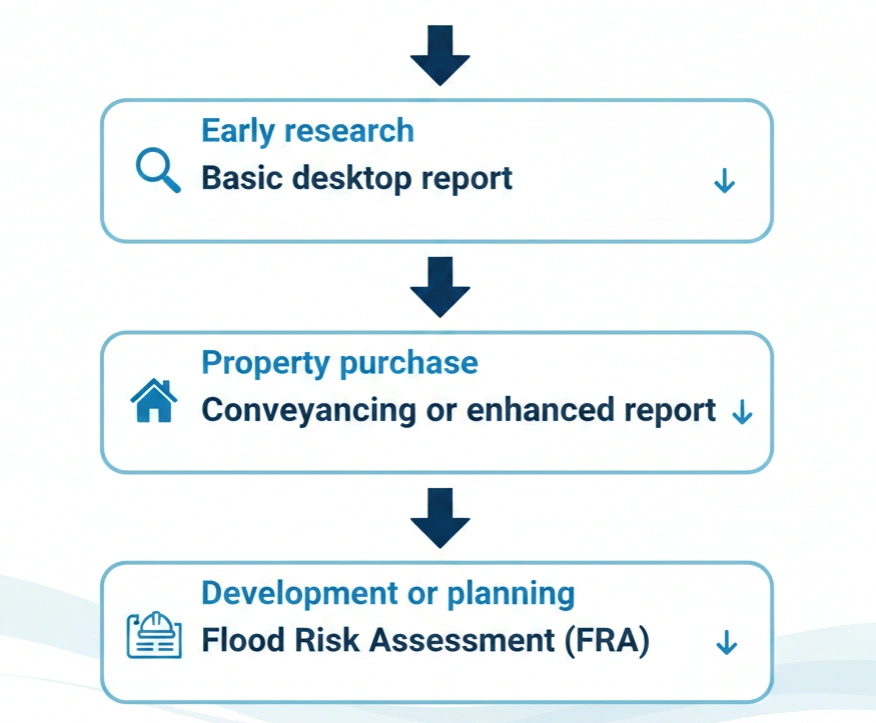
Selecting the wrong type of report can result in delays, additional costs, or repeated assessments later in the process.
Conclusion
The price range of flood risk reports in the UK can vary greatly due to varying levels of detail, varying purposes of use, and differing professional interpretations. A lower cost report may meet the needs of a first time review or check of flood risk but a higher cost report will typically reduce the uncertainty associated with flood risk and therefore increase the value of the report to you as a potential buyer of a property.
Understanding the difference in types of flood risk reports and why they are priced differently will allow you to determine which type of report is best suited to your needs.
Frequently Asked Questions
Yes. Flood Re is a joint effort by the U.K. government and the insurance sector that aims to make flood insurance both affordable and available to all homeowners who are considered to have a high risk of flooding from their properties. According to the GOV.UK website, the current expectation is that this program will continue until 2039.
The report costs start from £150. The report will indicate whether your home has a "low" or "manageable" flood risk. If it does, then generally speaking, the report cost is the only cost associated with the assessment process. However, if the report indicates that your home has a "high flood risk" and no flood defences, your lender may want a Flood Risk Assessment (FRA) or a physical inspection to confirm the level of flood risk, which would mean the cost of the assessment would be much higher (£750+) than the original cost of the report.
For property purchases: Generally speaking, a Flood Risk Property Report should be enough unless you've been told by someone involved in the purchase of the property that you'll need a more detailed assessment. It's usually not necessary to go straight into getting a more expensive engineering level assessment.
For Planning Applications: If you're developing land in a Flood Zone 1, you can often ask the local authority for a Letter of Support or a Flood Risk Statement rather than a full Flood Risk Assessment (FRA). The requirements of the local authority will depend on what they require.
A Flood Risk Assessment (FRA) is required for planning when the proposed development is in an area at risk of flooding (such as Flood Zones 2 or 3), or when the development could increase flood risk elsewhere.You may also need to obtain an FRA if you're developing in a Flood Zone 1 for specific types of developments or if there are additional risks of flooding that are present at the site (e.g., surface water flooding).