
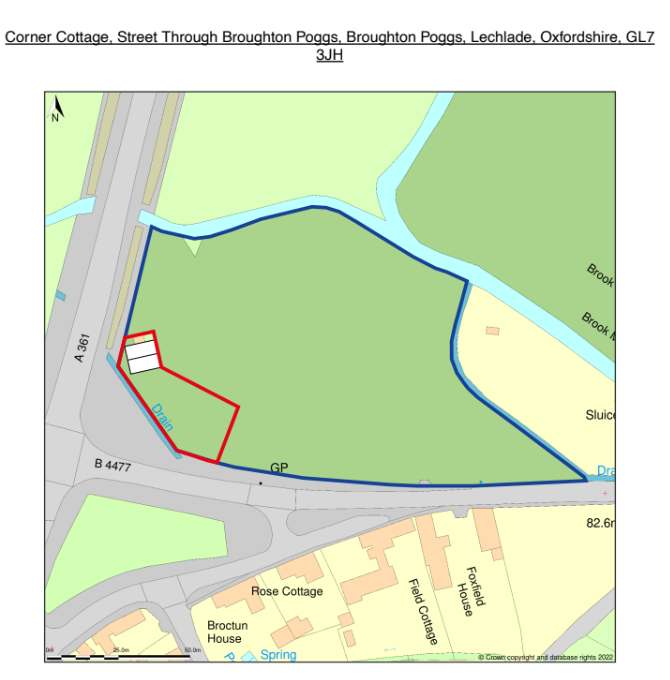
Land at Broughton Poggs
The Brief
RIDA Reports Ltd was commissioned to undertake a detailed flood risk assessment for a proposed development at Land at Broughton Poggs, GL7 3JH. The project involves the construction of a replacement outbuilding—intended for uses ancillary to the site’s current function as residential equine paddocks—covering a total development area of approximately 900 square metres. Located 20 metres from the Broadwell Brook, the site’s environmental characteristics required thorough investigation to ensure the safe and sustainable design of the new structure.
Why the Client Chose RIDA
The client sought a consultancy with a strong track record in delivering precise, technically rigorous flood risk assessments that align with local and national planning policies. RIDA was selected for its expertise in identifying complex site-specific constraints and devising practical, compliance-driven mitigation strategies to seamlessly support rural development projects.
The Challenge
The primary constraint for this site was its location within Flood Zone 3, representing a high probability of fluvial flooding from the nearby Broadwell Brook, with an expected design flood depth of 0.7m. Additionally, British Geological Survey data indicated a high susceptibility to groundwater flooding emerging above ground level, driven by the underlying Alluvium and Limestone geology. While surface water, sewer, and reservoir risks were determined to be low or very low, ensuring the ‘Water compatible’ development satisfied the National Planning Policy Framework (NPPF) without increasing off-site flood risk required careful evaluation of the combined fluvial and groundwater hazards.
The RIDA Difference
RIDA conducted a detailed flood risk assessment to formulate a comprehensive mitigation strategy tailored directly to the identified fluvial and groundwater risks. To combat the fluvial threat, RIDA established that the finished floor levels of the outbuilding must be raised 300mm above the 1 in 100-year plus climate change flood level, setting the target elevation at 84.30m AOD. To manage the high groundwater risk, RIDA advised installing a tanking membrane up to 200mm above ground level and ensuring overland flow paths around the structure were maintained to safely accommodate any emerging groundwater. Furthermore, the assessment confirmed that due to the structure’s scale and permeable access road design, specific floodplain compensation was not required, and surface water runoff would be sustainably managed using SuDS principles.
The Outcome
The detailed flood risk assessment successfully demonstrated that the proposed replacement outbuilding could be safely developed in accordance with NPPF requirements and Environment Agency guidelines. By establishing clear, robust flood resilience measures for both fluvial and groundwater risks, the report provided the necessary technical evidence to ensure the development would not increase flood risk elsewhere, effectively supporting the client’s planning application.