
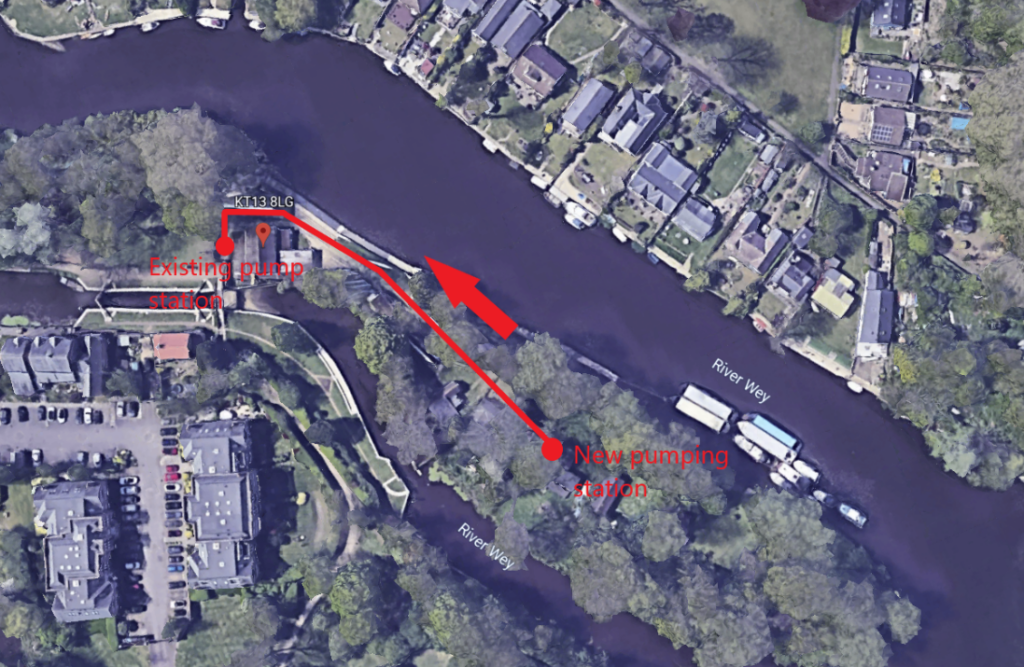
Weybridge Rowing Club, Thames Lock
The Brief
RIDA was instructed to provide a detailed flood risk assessment for a proposed development at Weybridge Rowing Club, located at Thames Lock on Jessamy Road. The project involves the construction of a new pumping station and rising main covering a total development area of approximately five square metres. Set on a greenfield site situated just eight metres from the River Thames, the proposals required careful technical evaluation to ensure long-term safety and operational resilience.
Why the Client Chose RIDA
Given the site’s immediate proximity to a major watercourse, the client required specialist technical support to navigate strict National Planning Policy Framework (NPPF) guidelines. They selected RIDA for their proven expertise in delivering robust flood risk assessments that identify precise flood depths and formulate pragmatic, site-specific mitigation measures for specialised utility infrastructure.
The Challenge
The primary constraint for the site was its location within Environment Agency Flood Zone 2, indicating a medium probability of fluvial flooding from the adjacent River Thames, with anticipated design flood depths reaching 1.65 metres. Alongside river flooding, the assessment identified a high risk of groundwater flooding due to the underlying geology, and noted that the site falls within an area with a high level of recorded sewer incidents. Furthermore, access and site constraints dictated that the new equipment could not be elevated above the calculated 12.146m AOD design flood level, requiring a highly resilient engineering approach to protect the infrastructure.
The RIDA Difference
RIDA undertook a detailed flood risk assessment, applying the NPPF sequential risk-based approach to classify the pumping station as a ‘Water compatible’ development, thereby confirming its suitability for Flood Zone 2.
To overcome the inability to raise the equipment above the design flood level, RIDA linked specific mitigation strategies directly to the identified fluvial and groundwater risks. RIDA outlined a strict water exclusion strategy for the infrastructure, which will be installed at a level of 10.3m AOD. To protect against water ingress, the assessment specified that the new kiosk must be fully sealed and waterproofed, with all service entries strictly sealed using expanding foam or closed-cell insulation. To manage residual risks, RIDA identified a safe evacuation route via Jessamy Road and recommended that personnel register for Environment Agency Flood Alerts while establishing a formal Flood Management and Evacuation Plan.
The Outcome
The detailed flood risk assessment successfully demonstrated that the new pumping station and rising main can be developed safely and in full accordance with NPPF, Environment Agency, and local planning authority requirements. By detailing highly specific waterproofing and sealing measures, the report confirmed that the equipment will be protected throughout its estimated 50 to 100-year design life without increasing flood risk elsewhere or requiring flood compensation, providing robust technical evidence to support the development.