
Flood Risk Management Authorities Under the Act
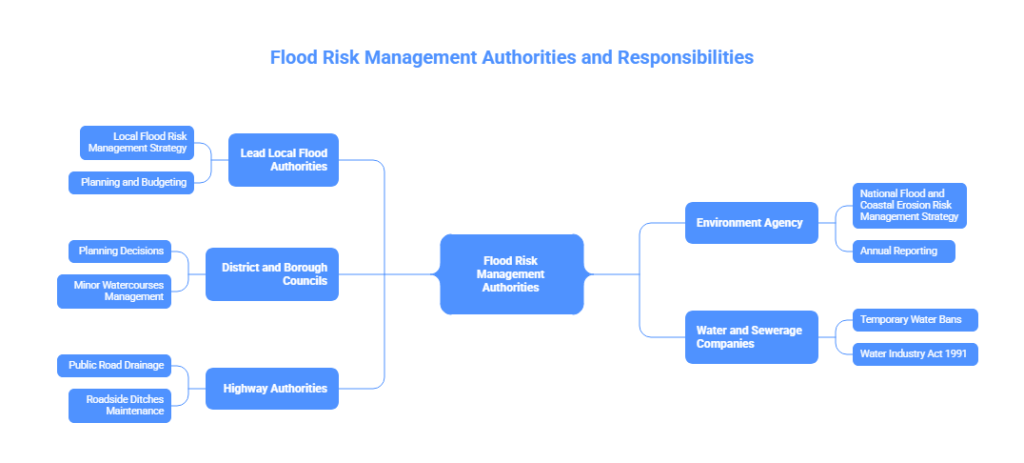
The Flood and Water Management Act makes it clear that floods can not be managed by a single authority without coordination. So this Act clarifies the role and responsibilities of all the flood risk management authorities of England.
It also states that data should be shared among authorities, and all authorities should coordinate. This makes sure to effectively manage flood risk in the UK and improve flood infrastructure without burdening a single authority.
All the risk management authorities that come under the Flood Management Act, and what their responsibilities are:
Lead Local Flood Authorities (LLFAs)
The lead local flood authorities play a central role according to the Flood and Water Management Act 2010. LLFA is a government body that handles the local flood risk management strategy. In England, this role is either given to a Unitary authority or a county council. On the other hand, it is handled by the county council or the county borough council in Wales.
Under the section Flood and Water Management Act’s sections 9 and 10, LLFA is responsible for creating the Local Flood Risk Management Strategy. This strategy focuses on managing local floods and implementing preventive and protective measures, and on how much everything will cost. It ensures LLFAs lead planning and budgeting for local flood resilience.
Environment Agency (EA)
The Environment Agency leads flood and coastal erosion risks in England. This agency also manages flood defences. According to the Flood and Water Management Act 2010, Section 7, the Environment Agency is responsible for preparing the National Flood and Coastal Erosion Risk Management Strategy (FCERM)
The FCERM describes the role of all the risk management authorities, such as councils, LLFAs, etc. The strategy also has the job to oversee how other authorities are performing their duties and make sure they work according to national policy.
Section 18 of the Act states Environment Agency has to provide an annual report explaining how flood and coastal erosion risk are being managed. What plans are made for the future, and what is the current progress of LLFAs’ local strategies?
The FCERM was updated in 2020 and now has three main ambitions to fulfil:
- Create resilient infrastructure.
- Create climate resilient places.
- A nation prepared to face flooding and coastal change.
District and Borough Councils
District and Borough councils manage planning and ordinary watercourses at the local level. These councils handle planning decisions and decide if a development is face in certain areas.
These councils also manage minor watercourses which are not covered by internal drainage boards. They also work with LLFAs to make sure new developments have proper drainage and flood safety.
Water and Sewerage Companies
The Flood and Water Management Act 2010, sections 35 and 36, upgraded the Water Industry Act 1991. According to the new change, water companies have the authority to put a temporary water ban during a water emergency or shortage.
Highway Authorities
National Highways and Local Highway Authorities manage public road drainage and roadside ditches. This authority also manages and maintains road drainage systems to avoid water police on roads.
How the Act Affects Planning and Development in England
The Flood and Water Management Act has affected the planning and development policies in England positively. Now it is compulsory for any development in zones 2 and 3 to have a specific on-site flood risk assessment.
Now, planning rules like sequential tests and exception tests rely on input from LLFs and the Environment Agency. This Act also promotes the implementation of sustainable drainage systems in new developments. In short, the Flood and Water Management Act has made flood risk considerations mandatory at every stage of development.
RIDA reports is an expert at providing surfaces for flood risks across England and follows the Flood and Water Management Act 2010 closely. We make sure our risk assessment report follows the national policies, and we provide effective, sustainable drainage system services as well.
Schedules Under the Flood and Water Management Act 2010
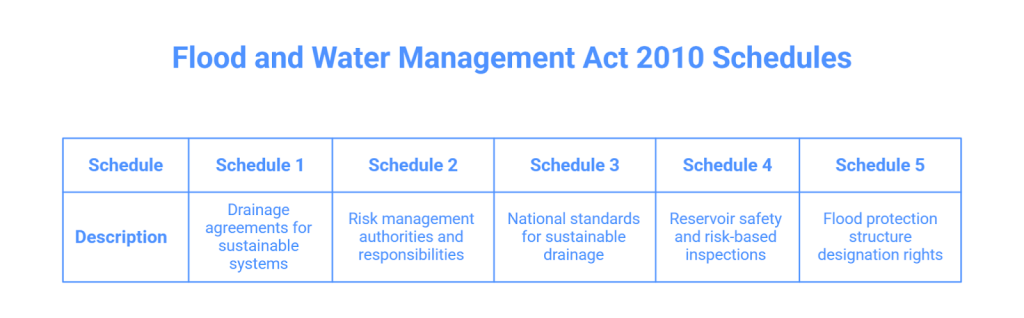
Schedules are detailed appendices that explain the details of the Flood and Water Management Act 2010. There are a few schedules supporting the main policies of the Act.
Schedule 1:Schedule 1 outlines how developers must enter drainage agreements to add sustainable drainage systems in new developments.
Schedule 2: This schedule focuses on identifying risk management authorities and their responsibilities.
Schedule 3:This is the most discussed schedule of the Act. It focuses on setting national standards for sustainable drainage systems. This schedule also implements that developers are no longer allowed to connect surface water to drainage without local SuDS Approval Body.
Schedule 4:This schedule focuses on reservoir safety. Now, reservoirs have to be inspected using a risk-based system. Basically, it checks if reservoirs fail, and then how the population living under or near them will be affected.
Schedule 5: Schedule 5 gives the right to flood authorities to designate certain structures for flood protection, and no one is then allowed to remove or move them without legal permission.
In short, these schedules help in understanding the Flood and Water Management Act in detail. These schedules also make prevention and protection strategies easy to implement and monitor.
What Happens If a Property Is Flooded?
The Flood and Water Management Act also provides guidance on investigation and response to a flood. Section 19 of the act gives the right to LFFA to first decide if a flood incident should be investigated or not.
Most flood incidents trigger an investigation, and Act 19 also gives this job to LFFAs. The LFFA investigates the property and has to provide an investigation flood report.
The investigation aims to establish:
- What happened and why.
- Which risk management authorities or other parties were responsible for parts of the drainage/flood management system involved?
- Recommendations on reducing future flood risk.
How to Access the Flood and Water Management Act 2010
The text form of this Act is available on the official legislation website. Some government and agency sources also provide authentic information related to the Flood and Water Management Act 2020.
The gov.uk also published the Acts online, including schedules and amendments. You can also find data and guidance on flood risk on the Environment Agency website. The website also publishes flood maps for planning and assessment reports.