
Flood Risk and Property Insurance

Flood risk is one of the most common factors influencing home insurance decisions for buyers and homeowners in the UK. Even where a property has never flooded, mapped flood risk can still affect insurance availability, premium levels, policy excesses, and the terms under which cover is offered.
Insurers assess flood risk using a combination of predictive flood modelling, historical flood records, and local drainage information. As a result, properties identified as being at higher risk may face higher premiums, increased excesses, or fewer insurers willing to offer cover, even in the absence of past flooding.
To help address this issue, the UK government and insurance industry jointly established Flood Re. Flood Re is a reinsurance scheme designed to improve the affordability and availability of flood insurance for homes at higher flood risk. It allows participating insurers to pass the flood risk element of eligible household policies to Flood Re, enabling them to offer more competitively priced insurance to homeowners who might otherwise struggle to obtain cover.
Flood Re primarily helps:
- Owners of residential properties built before 1 January 2009
- Homeowners living in areas with a known or modelled flood risk
- Properties that may otherwise face prohibitively high flood premiums
While Flood Re plays an important role in supporting insurability, it does not remove the need to understand flood risk properly. Eligibility criteria apply, and not all properties or policy types are covered. Insurers still assess flood exposure when underwriting policies, and flood risk can continue to influence excess levels and policy conditions.
This guide explains how flood risk affects property insurance, how insurers assess flood exposure, and how flood risk report can support informed insurance and property decisions before committing to a purchase.
Does flood risk affect home insurance?
Yes. Flood risk can have a significant impact on your home’s insurance. When they price your policy, set the level of your excess, and decide whether to insure you at all, insurers evaluate the flood risk at your location
A property does not need to have flooded previously for flood risk to influence insurance outcomes. Many insurers will use predictive flood modeling, historic data sets, and local drainage information to determine what their level of flood risk is for your property.
As a result, flood risk can affect:
- Insurance availability
- Annual premiums
- Flood excess amounts
- Policy exclusions or conditions
How insurers assess flood risk
When underwriting a property, insurers typically consider a combination of a model that is based on nationwide data, as well as local information regarding the property.
Common factors include:
- River and coastal flood risk
Proximity to rivers, streams, and tidal areas. - Surface water flood risk
Risk of excessive amounts of rain causing a property’s stormwater system to be overwhelmed. - Historical flood events
Flooding has affected either the property itself, or other properties in the immediate sorroundings of the property.
- Proximity to watercourses
Minor water courses can also affect how high a property’s risk rating is.
- Local flood defences and resilience measures
The presence, condition, and standard of protection offered by flood defences.
A flood risk assessment provides insight into how these elements impact the specific property being evaluated, rather than making assumptions about a location based upon a particular postcode.
Can you get insurance if a property is at flood risk?
In many cases, yes. Properties identified as being at some level of flood risk are often still insurable. However, flood risk may lead to:
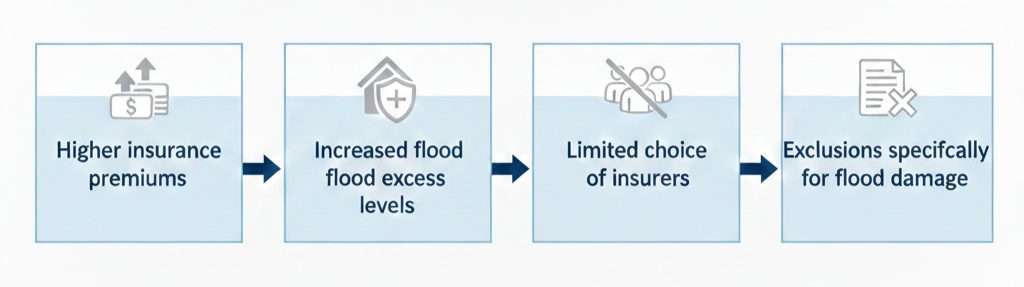
The main problem is determining if the identified flood risk is hypothetical (modeled but highly unlikely), or material (highly likely to affect both the ability of an insurer to offer coverage for a given piece of property and to affect the number of claims made on that policy).
The reason this distinction is so important at the time of purchase of a piece of property is because of the ability of an insurer to provide coverage for a given piece of property can determine whether a lender will approve a mortgage, which in turn may affect the progress of a property transaction.
Understanding theoretical vs material flood risk
While all the mapped flood risk does not necessarily translate to an actual problem with insuring the subject property, some properties are located in broad flood zones but have other factors that mitigate their exposure to flood risks such as:
- Elevated ground levels
- Local drainage improvements
- Effective flood defences
- No history of flooding
Without interpretation, raw flood data can appear more severe than the practical risk faced by the property.
How a flood risk report helps with insurance decisions
A professional flood risk report provides evidence-based insight into how flood risk affects a specific property. Rather than simply flagging risk, it explains:
- The type and source of flood risk
- The likelihood of flooding affecting the property
- Whether flood risk is likely to impact insurability
The Flood Property Report (FPR) is an extension of the FPR framework which interprets flood risk within an insurance/transactional context, providing potential buyers/homeowners/solicitors with an assessment of whether there is likely to be a practical impact on them as a result of flood risk.
This will reduce the uncertainty surrounding the purchase process, avoid unnecessary withdrawal from purchases, and provide clarity for solicitors to inform their clients and discuss flood risk with their Insurers/Brokers.
Practical tips for buyers and homeowners
- Check insurance availability early in the purchase process
- Do not rely solely on flood risk data provided at a postcode level to assess flood risk.
- Use an interpretive flood risk report where risk is flagged
- Discuss findings with an insurance broker if risk appears elevated
Early clarity regarding potential flood risks in the home buying or selling process may help avoid any delays in the transaction and/or unforeseen costs further into the transaction.
Conclusion
Flood risk has a significant impact on the pricing and offering of home insurance in the UK. Many homes with varying degrees of flood risk continue to be insurable but the terms under which they are insured by different insurers can vary greatly based upon each insurer’s interpretation of the degree of exposure to flooding.
A professional flood risk report can provide buyers and homeowners with an understanding of how flood risk may impact their ability to obtain insurance, increase costs over time, or ultimately affect long term ownership before making critical decisions.
Frequently Asked Questions
The UK's "Flood Re" program was created by the UK government and the UK's private insurance companies to provide reasonably priced flood coverage to those who live in houses at high risk of flooding.
You buy insurance as normal. If you are one of the many who live in a house with a high flood risk, the insurance company providing your policy will pass the flood portion of the policy to Flood Re for a set price. This should result in reduced premium and excess costs for you.
Eligibility: Generally applies to residential properties built before 1 January 2009. Most leasehold flats and holiday homes are eligible, but buy-to-let properties and businesses are not.
Standard buildings and contents policies generally cover damage resulting from natural flooding events (such as when a river overflows its banks, or during a storm surge). The types of coverage provided include:
- Buildings Insurance: Provides for repair of structural damages, drying of the property, removal of debris and other expenses related to repairing or replacing damaged building elements.
- Contents Insurance: Provides for the replacement of furniture, carpets, clothing, etc. due to loss or damage caused by flooding.
Exclusions: Standard policies often exclude "escape of water" (e.g., burst pipes) from the "flood" definition (this is covered under a separate clause), damage to gardens/fences, and vehicles.
Yes, it may be a little harder to get flood insurance if you've had a flood event previously, but it is possible. Mainstream insurance providers may choose to deny coverage to you, so you could contact the British Insurance Brokers’ Association (BIBA) for assistance finding a specialist broker who can assist you. You might also be asked to provide a Flood Risk Report to prove you have installed resilient measures.
The "Build Back Better" program is offered by participating insurance companies in conjunction with Flood Re. For every flood claim made by a homeowner insured through the Build Back Better program, the insurance company can pay up to £10,000 to assist the homeowner in installing flood mitigation measures, including flood-proof doors, raised electrical outlets, etc.