
Flood risk assessment cost is often an unexpected factor when planning a new home, extension, or development. Everything can seem straightforward until you receive a message from the planning officer:
“Submit a flood risk assessment, please”.
The majority of landowners, architects, developers, and homeowners learn about this requirement after they’ve submitted their planning application. The next important question typically comes up at this point:
“How much does a flood risk assessment cost?”
This guide breaks the process down clearly so you know what to expect before you begin.
To better understand the flood risk affecting your site or property, explore RIDA’s flood risk assessment services
What is a flood risk assessment?
A flood risk assessment is a document that shows the council how flooding might affect the development, and how it might affect flooding elsewhere.
What is considered
- Flood history
- Water levels
- Surface water flow
- Drains and runoff
- Nearby rivers or streams
- Ground levels
- The level of safety
- What steps are required to lower the risk of flooding?
Levels of flood risk reports
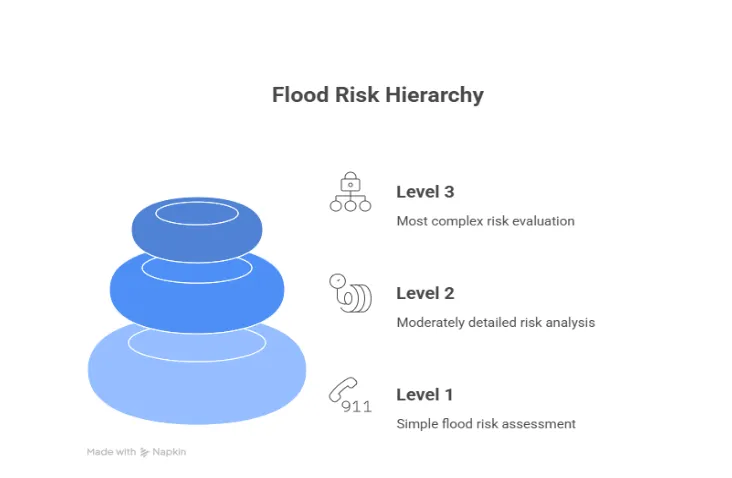
Level 1- Fundamental desktop evaluation
This is the simplest type. Planning documents, maps, and general data are its main sources.
Used for small plots in low-risk zones, single homes, and minimal extensions.
Level 2- Detailed assessment
This includes a more thorough examination, drainage inspections, and even a site visit.
Used for moderate-sized projects, waterfront developments and medium risk locales.
Level 3- Advanced modelling assessment:
This includes calculations, flood modeling, and more analysis.
Used for bigger developments, flood zone 3 areas, and complex or high-risk sites.
Average Flood Risk Assessment Cost in the UK (2026 Update)
The cost varies based on how complicated or risky the site is. Below are realistic starting prices used across the industry, supported by examples from UK Consultancies.
Level 1 flood risk assessment cost
Starts from£450
- Appropriate for small and simple sites
- No modeling needed
- Based on existing data
Level 2 flood risk assessment cost
Starts from £750
- Frequently required for flood zone 2
- More detailed than level 1
- May involve a site visit
Level 3 flood risk assessment cost
Starts from £1250
- Hydraulic modeling is included
- Used for complex sites near rivers
- Often required for developments in flood zone 3
Why do some reports cost much more?
A thorough evaluation takes more time and can call for specialized equipment. What is required?
- Site visits
- Surveys of topography
- Drainage studies
Prices vary greatly based on site complexity and risk, which can be explained by these extr requirements.
Key factors that influence flood risk assessment cost
Factor | How does it affect the cost? | Example |
|---|---|---|
Size of the development | Larger developments are typically more expensive | Converting a garage is significantly less expensive than building a new apartment complex |
Location | A more thorough evaluation is necessary for locations close to lakes, rivers, or the ocean | A property next to a river may need additional flood modelling |
Council requirements | Some councils have additional regulations that increase expenses and time. | There may be a requirement for additional drainage reports or climate change allowances |
Delivery speed | Faster turnaround may result in higher cost | Reports that must be completed within a few days are frequently more expensive |
Type of data | Additional or specialised data would need to be purchased | Flood data from the environmental agency or topographical surveys may be required |
Complexity | Assessment time is increased by challenging terrain | Steep slopes, culverts, old drains, or uneven ground may require analysis |

Hidden costs that can increase your flood risk assessment price
While many projects fall within standard pricing ranges, certain factors can increase the overall flood risk assessment price beyond initial estimates.
Understanding these variables helps avoid surprises later in the planning process.
A number of factors can increase the cost of an initial flood risk assessment above the standard costs associated with standard projects. Identifying potential variables from the beginning will help avoid costly surprises in the future.
1. Climate change allowance requirements
Climate change guidance has been updated by the Environment Agency, which may need:
- Additional modelling
- Higher flood level scenarios
- Extended hydraulic calculations
The additional technical work associated with this additional modelling will likely result in increased costs.
2. Sequential or Exception Test Requirements
Where a development lies within Flood Zone 2 or 3, the local authority may request that the applicant undertake a:
- Sequential Test
- Exception Test
This requires preparing and integrating them into the flood risk assessment report and is therefore likely to add to the time and complexity of producing the report and its cost.
3. Hydraulic Modelling for Complex Sites
For Level 3 assessments, hydraulic modelling (which involves amongst other things, topographical survey data; river modelling; surface water modelling; flood depth and velocity calculations etc.) is typically undertaken on sites where there are complex hydrological inputs e.g. large rivers.
The undertaking of hydraulic modelling is one of the most expensive components of a flood risk assessment particularly when it relates to large or high risk developments.
4. Council-Specific Requirements
These additional elements increase report preparation time and technical input.
There are some local authorities who may have specific requirements for the content of a flood risk assessment report including (but not limited to):
- Drainage strategies to be included in the flood risk assessment report
- Compensatory flood storage calculations to be undertaken;
- Detailed assessments of safe access to buildings/structures affected by flooding.
The inclusion of these additional items in the report preparation process will both increase the time required to prepare the report and the amount of technical input required
5. Revisions Following Planning Comments
If comments are received from the council requiring clarification or amendment to the assessment, additional analysis may be required. The earlier that a qualified assessor is engaged the less likely it is that costly revisions will be needed to address the comments made by the council.
How a flood risk assessment is carried out?
(i) Initial chat and scoping
- To learn more about the nature, scope, and location of the project, the assessor gets in touch with the customer.
- Determines which level of flood risk assessment (Level 1, 2, or 3 ) is required based on the flood zone, development zone, and complexity.
- Explains dates, local authority regulations, and any specific concerns about drainage or flood history
(ii) Desktop review and data gathering
- Examines Environment Agency documents and official flood maps
- Examines local drainage infrastructure, rainfall data, and past flooding episodes
- Checks the site layout, topography, and nearby watercourses to identify potential flood pathways
- Gathers any relevant council guidelines or climate change allowances that might have an impact on the evaluation
(iii) Site visit:
- For medium or high-risk developments, the assessor visits the location.
- Confirms ground levels, slopes, surface water flow, and drainage features
- Takes note of any ground conditions, such as steep embankments, clogged drains, or old sewage pipes
- Takes photographs of the location for the final report’s documentation
(iv) Analysis:
- Evaluates the danger of flooding from groundwater, surface water,and rivers
- Conducts hydraulic modelling for complex or high-risk sites(usually level 3)
- Predicts the influence on the development by calculating the flood depth, flow patterns, and velocity.
- Finds places where water might collect or spill onto nearby homes
(v) Suggestions for mitigation:
- Recommends practical steps to lower the risk of flooding
- Installing flood barriers or raising floor levels
- Using sustainable drainage systems
- Rerouting runoff to secure locations
- Ensures that mitigation measures comply with local planning policy and Environment Agency guidance.
(vi) Final report:
- Creates a report that is ready for planning by compiling all conclusions, calculations and suggestions
- Includes maps, diagrams, tables and supporting documentation.
- As part of the planning application, the report is sent to the local planning authority.
- Determines whether additional measures, like more polls or continuous observation, are necessary.
Flood risk assessment cost for planning permission vs informal reports
Although not all flood risk assessments are alike, the average flood risk assessment cost for planning permission will generally exceed the cost of an informal flood screening report due to increased scope, accountability and regulatory expectations.
Flood risk assessment for planning permission
A formal Flood Risk Assessment (FRA) prepared for a planning application must:
- Follow the National Planning Policy Framework (NPPF)
- Address Environment Agency flood zones
- Consider climate change allowance
- Evaluate access/egress safety
- Include mitigating measures
- Demonstrate no increase in flooding elsewhere
As the FRA is a statutory planning document it should therefore be robust and defendable against review by both local authority planners and consultees.
Due to these requirements, the flood risk assessment for planning costs can range from £450 for small sites to over £2,000 depending upon flood zone and modeling needs.
Flood risk survey cost (Informal or preliminary reviews)
An informal flood risk survey costs less as it may include:
- Only a site visit
- Visual inspection of drainage and topography
- Basic flood map review
- No formal planning submission document
While a site visit and/or basic survey may not be enough to meet the requirements of the planning authority for a submitted development, an informal survey will likely never replace a full Flood Risk Assessment report if the development is to be formally submitted to the relevant authorities.
Understanding this distinction helps avoid underestimating the required scope and budgeting correctly from the outset.
Who performs the assessment? Choosing a qualified flood risk assessor
A good flood risk assessor helps prevent planning delays, avoid extra costs, and ensures the project is safe.
Always look for assessors with experience in
- UK planning guidelines
- Hydrology and drainage
- Flood modelling
- Local government regulations
- Designing practical mitigations
Rida reports specialises in flood risk assessments for homeowners, planners, developers, and architects.
Practical examples of flood risk assessment applications
Below are professional, industry standard examples that demonstrate how different development types typically require different levels of flood risk assessment. These reflect common scenarios seen across the UK planning system and align with national flood risk guidance.
1)Single home extension in flood zone 1 (Low risk)
A homeowner is planning a small extension in an area classified as flood zone 1, meaning the state has very low probability of flooding.
What was needed?
- A level 1 desk-based evaluation, since only basic screening was required.
- A review of:
- Government flood maps
- Surface water flow routes
- Records of drainage
- Site topography
- No hydraulic modelling
- No site visit
Typical cost:
This type of project demonstrates that low-risk sites typically only need a basic assessment to show planners the extension will not increase flood risk.
2)Residential development with 8-12 units close to a watercourse(Flood zone 2)
A medium-sized residential development located close to a small river sits within flood zone which represents a medium probability of flooding
What was needed?
- An evaluation of flood risk at level 2
- Verification of ground levels and drainage limitations through site examination
- Review of historic flood records
- Examination of safe access and escape routes
- Mitigation recommendations
Typical cost:
This shows how greater site-specific evaluation is needed for developments close to watercourses in order to show that newly constructed residences are still robust and safe.
3)Large commercial development (Flood zone 3)
A commercial project situated alongside a tidal river lies within flood zone 3 , which is designated as a high-risk flood area.
What was needed?
- An evaluation of level 3 flood risk that includes
- Advanced modeling of hydraulics
- Data from topographical surveys
- Flood depth and mapping of hazards
- Compensatory flood storage design
- Emergency preparation methods and flood resilience
- Thorough evaluation of drainage impact
- Climate change allowances implemented in accordance with official directives.
UK Flood risk assessment pricing & delivery comparison
Flood risk assessment companies operate under distinct service structures, which directly influence cost, speed of delivery, technical depth, and planning support.
| Company | FRA-Extension | Timescale (Extension) | FRA + Drainage Strategy- Single House | Timescale (FRA + DS) | Drainage Strategy-3-4 Houses | Timescale (DS 3-4) |
|---|---|---|---|---|---|---|
Provider A | £780 + VAT | Draft within 10 working days | £2,395 + VAT | 4 working weeks | _ | _ |
Provider B | £950 + VAT | 5 working days | £2,185 + VAT | 10-15 working weeks | £1,095 + VAT | 10-15 working weeks |
Provider C | £1,200+ VAT | 2 weeks from instruction | _ | _ | _ | _ |
Provider D | £995+ VAT | 7-10 days | £870+ VAT (FRA only stated) | 10 Working days | _ | _ |
RIDA Reports | £750 | 48 Hours (first draft) | £900 (FRA) + £750 (DS) | First draft within 5 Working days | £1500 | First draft within 5 Working days |
Flood risk assessment companies operate under distinct service structures, which directly influence cost, speed of delivery, technical depth, and planning support.
Frequently Asked Questions
A document outlining how hazards will be controlled and how floods might impact the development. Required by councils for certain sites.
A flood risk assessment is needed for developments in Flood zone 2 or 3 , large sites in Flood zone 1, or sites near rivers, tidal areas or surface water.
Yes. A properly prepared flood risk assessment helps demonstrate compliance with national planning policy and environment agency, reducing the likelihood of planning objections or delays.
A flood risk assessment usually includes site maps, flood risk data, analysis of possible effects, mitigation strategies and suggestions to guarantee the developments is safe and does not raise flood risk elsewhere.
The flood risk assessment cost will differ based on:
Classification of the flood zone for that area (Zone 1, 2, or 3)
The size and type of development being proposed
Whether or not there is a requirement to produce hydraulic models for the site
If the development requires compliance with climate change allowance
Whether there are specific drainage strategy requirements for the site
Where a site has unique complexities or higher risks, then the consultants will have to undertake further technical analysis which will increase both their professional time and modeling input.
Unless otherwise agreed upon in the contract, flood risk assessments are subject to VAT when commissioned as a professional consultancy service. The VAT status can also vary depending on the type of client and the contractual agreement with the consultant. It would be prudent to confirm the VAT treatment at the quotation stage.
Our typical timearound for completing a flood risk assessment is:
- Between 2-5 working days for simple residential extensions
- Between 5-10 working days for standard residential developments
- Between 2-4 weeks for complex or modeled assessments in Flood Zone 3
As stated above, the completion timearound will depend on the amount of data available, whether the consultant needs to perform modeling work for the site and the complexity of the site itself.
A flood risk assessment is not just a planning requirement, it protects your development, avoids delays and ensures safety. Report level and site complexity affects costs. Early professional guidance saves money and time