
You are not alone if the Lead Local Flood Authority has requested feedback from you while you are preparing a planning application in England. For many homeowners, small developers, and architects, this is the time when flood danger suddenly becomes perplexing, technical, and worrisome.
Flooding is a serious and growing concern in England. Heavy rain causes surface water flooding, which now threatens more properties than river or coastal floods. Different authorities handle different flood types. At the local level, county/unitary councils act as Lead Local Flood Authorities (LLFAs), coordinating local flood risk management as part of the wider framework used when preparing a flood risk assessment for planning applications.
This article explains the LLFA role in plain English. We’ll clarify what an LLFA is, how it differs from other agencies (notably the Environment Agency), and when homeowners or developers should work with their LLFA.
What Is a Lead Local Flood Authority (LLFA)?
Lead Local Flood Authority (LLFA) is the term for the local councils that lead on flood risk in their area. In England, the LLFA is the country council for two-tier areas or unitary councils for one-tier areas. For instance, if you live in Oxfordshire, Oxfordshire County Council acts as your area’s LLFA.
The role of Local Lead Flood Authority was created by the Flood and Water Management Act 2010 as part of the post-2007 flood reforms. These authorities are tasked under this act to manage local flood risk.
They are responsible for flood risks that do not originate from large rivers or the ocean. These dangers are sometimes difficult to perceive yet are among the most common causes of floods and planning concerns.
A Lead Local Flood Authority is responsible for managing:
- Surface water flooding caused by heavy rainfall
- Groundwater flooding where water rises from below the ground
- Flooding from ordinary watercourses such as streams and ditches
In the planning process, the Lead Local Flood Authority advises the local planning authority on whether development proposals manage water safely and responsibly.
Legal Duties of Lead Local Flood Authorities Under the Flood & Water Management Act 2010
After extensive flooding throughout the United Kingdom revealed flaws in the management of flood risk, the Flood and Water Management Act 2010 was introduced. The establishment of Lead Local Flood Authorities was one of the most important results of this act.
Under the Act, Lead Local Flood authorities must:
- Maintain an Asset Register. LLFAs must record significant flood-risk assets (culverts, flood barriers, pumping stations, etc.), noting their ownership and condition. This public register helps track what needs repair.
- Investigate Flood Incidents. After a significant local flood event, LLFAs are required by law (Section 19 of the 2010 Act) to investigate the causes and publish a report with findings. This can include analysing rainfall, river flows, blocked drains or other factors, and recommending fixes.
- Act as Statutory Consultee in Planning. For major developments (typically 10+ homes or sites over 1 ha), the LLFA must be consulted on surface water drainage. They review developers’ Flood Risk Assessments and drainage designs, and can object or recommend conditions if flood risk isn’t properly managed.
- Regulate Watercourse Works. Under the Land Drainage Act, LLFAs grant “consent” for any works (like culverting or bridge-building) on ordinary watercourses. They ensure changes don’t increase flood risk and can require maintenance of those channels.
- Emergency Response and Cooperation. LLFAs are Category 1 responders under the Civil Contingencies Act, so they must help plan for and respond to flooding emergencies. They work closely with the Environment Agency, water companies, IDBs and emergency services to coordinate warning, response and recovery.
This law changed the focus of flood management from emergency response to long term planning, prevention, and responsibility.
Lead Local Flood Authority vs Environment Agency: Who Manages Flood Risk?
England’s flood governance is shared. Simply put: the Environment Agency (EA) handles the big-picture flood risks from main rivers, the sea and reservoirs, while LLFAs handle smaller-scale, local flooding from surface water, groundwater and ordinary watercourses. The EA says it is responsible for “taking a strategic overview” of flood risk, managing flood defenses on designated main rivers (major waterways) and coastlines, regulating reservoir safety, and issuing flood warnings. For example, the EA maintains flood barriers and tidal surge plans, and it publishes national flood maps and data.
By contrast, LLFAs cover everything else at community scale. A Commons Library briefing notes that “LLFAs are responsible for managing the risk of flooding from surface water, groundwater and ordinary watercourses”. In practice, think of it this way: if flooding comes from a big river or the sea, call the EA (or check EA flood alerts). If flooding is caused by an overwhelmed urban drain, blocked culvert, or rising spring in a local field, your LLFA and local highways teams are the ones in charge. One flood-info guide neatly summarises this division: the EA “is responsible for managing the risk of main river and coastal flooding”, whereas the “LLFA is responsible for managing flood risk from ordinary watercourses, surface water and groundwater”.
Flood risk source | Responsible authority |
Surface water flooding | Lead local flood authority |
Groundwater flooding | Lead local flood authority |
Ordinary watercourses | Lead local flood authority |
Main rivers | Environment Agency |
Coastal flooding | Environment Agency |
The Environment Agency’s flood risk responsibility offers national oversight and concentrates on flooding from rivers and the sea. Rainfall, drainage, and local ground conditions are the main concerns of the Lead Local Flood Authority
In reality, the Lead Local Flood Authority, rather than the Environment Agency, is the source of the majority of planning objections to floods.
The Role of the Lead Local Flood Authority in Planning Applications
For developers and consultants, one of the most important LLFA roles is as a statutory consultee on planning applications. This means that for certain projects the local planning authority must consult the LLFA on flood and drainage issues. Since April 2015, the rules have been clear: LLFAs must be consulted on major developments – typically defined as proposals for 10 or more homes or sites exceeding 1 hectare. This statutory duty comes from national policy (the National Planning Practice Guidance), which explicitly states that “the local planning authority will need to consult the LLFA on surface water drainage” for major development.
What do LLFAs do in this role? Simply put, they check that any proposed development will not increase flood risk and that adequate surface water drainage is provided. Specifically, LLFAs will review:
- Evaluations of flood risk
- Drainage strategies
- Calculations of surface water runoff
- Long term maintanence proposals
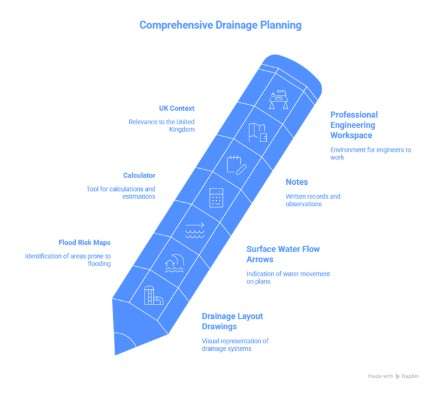
LLFAs will examine Flood Risk Assessments and drainage strategies to ensure they identify all flood sources and propose safe design.
Common reasons for Lead Local Flood Authority objections include:
- Too much runoff leaves the site
- Over-reliance on public sewers
- Lack of on-site water storage
- No allowance for suture climate change
Understanding these concerns early can significantly reduce planning delays.
How Lead Local Flood Authorities Manage Surface Water and Groundwater Flooding
One of the LLFA’s most critical responsibilities is managing surface water flooding. This is flooding that occurs when heavy rainfall overwhelms local drainage systems or flows across the ground.
Surface Water Flooding
When rainwater can’t seep into the earth or drain away fast enough, surface water flooding happens. This is especially prevalent in cities with a lot of hard surfaces.
Lead Local Flood Authorities assess:
- How water flows across a site
- Whether development increases runoff
- If the drainage systems are able to handle significant rains
They frequently call for drainage plans that hold water on site and slow it down before releasing it gradually.
Groundwater flooding
Groundwater flooding happens when underground water levels rise and emerge at the surface. It is often overlooked because it may occur after long periods of rainfall.
Lead Local Flood Authorities consider groundwater risk carefully for:
- Basement developments
- Low-lying sites
- Areas with clay, chalk, or high water tables
Ignoring groundwater flooding can lead to long-term damp and structural issues, even where river flooding is not a concern.
LLFAs focus on keeping local drainage systems working and encouraging better design. They map out ordinary watercourses (often showing on council GIS), regulate works on those watercourses, and enforce landowner duties to clear blockages. They advise homeowners and councils on maintenance (e.g., cleaning road gullies) and on property-level resilience (non-return valves, flood barriers, raised electrical fittings). All of this is aimed at reducing the impact of heavy rain on local communities. For example, Milton Keynes’ strategy explicitly includes “ensuring that new developments are designed and built in a sustainable manner which does not increase flood risk and which reduces flood risk whenever possible” – highlighting how important on-site drainage is.
Flood Risk Data Used by Lead Local Flood Authorities
When evaluating planning applications, Lead Local Flood Authorities mostly depend on government flooding data when assessing planning applications.
This includes:
- Long-term flood risk maps
- Surface water flooding maps
- Historic flooding records
These datasets are used alongside Environment Agency flooding maps, which focus on rivers and the sea.
Using the correct data sources demonstrates that flood risk has been assessed properly and helps build confidence in your planning submission.
Practical Flood Risk Management and Prevention Strategies
Beyond planning, LLFAs implement practical strategies and coordinate responses. Each LLFA’s Local Flood Risk Management Strategy will outline specific actions – such as targeted engineering schemes or catchment-wide projects.
When significant flooding occurs, LLFAs take action both during and after the event. As a statutory consultee and risk management authority, an LLFA will often join incident meetings alongside the Environment Agency, highways, water companies and emergency services.
LLFAs also work proactively. They frequently engage with local communities, businesses and landowners through “flood action groups” and awareness campaigns.
For property owners and developers, LLFAs often emphasize early flood risk advice. Consulting the LLFA before designing a project can save time: as one consultant guide warns, failing to meet LLFA drainage requirements often leads to planning refusals or delays.
Flood Risk, Drainage & Planning Support
Managing flood risk effectively often means bringing in specialist help. Leading developers and landowners frequently engage flood risk consultants or engineers to work with LLFAs. These experts (such as firms like Rediticos/RIDA in England) prepare the required studies and designs to align with LLFA and Environment Agency rules.
Beyond just compliance, good consultancy support can yield better outcomes. For example, a consultant will model rainfall scenarios (even exceeding local guidelines per UKCP18 projections) and test different SuDS layouts.
For homeowners and smaller businesses, locally qualified surveyors can help with property-level resilience: advising on flood-proofing measures or checking insurance-linked flood maps. Even in those cases, LLFAs can offer advice or leaflets (many maintain flood advice pages) and signpost grant funding (e.g. Property Level Resilience grants).
Finally, if in doubt about the LLFA’s view on a project, developers can request pre-application meetings with them (sometimes also involving local planners and the EA). These meetings are highly recommended; they allow all parties to flag issues early. The cost of such meetings is modest compared to the potential cost of a failed planning application.
Frequently Asked Questions
An LLFA is a local council (county or unitary) with the legal duty to manage flood risk from local sources. In England, every county council or unitary authority serves as its area’s LLFA. LLFAs were created by the Flood and Water Management Act 2010. Their job is to coordinate flooding from surface water, groundwater and ordinary watercourses (small rivers/drains).
In England, there are 152 Lead Local Flood Authorities.
Among them are:
- Councils of counties
- Authorities in a unit
- Borough councils in metropolitan areas
- Boroughs of London
Local flood risk management is the responsibility of each LLFA in its own region.
Yes. Coventry City Council is a Lead Local Flood Authority.
Because Coventry Iis a unitary authority, it hold LLFA responsibilities for:
- Surface water flooding
- Groundwater flooding
- Flooding from ordinary watercourses
Coventry City Council provides flood risk advice on planning applications and overseas local flood-risk management within the city.
Not always. The Lead Local Flood Authority is involved particularly when a development could influence surface water, drainage, or local floods. For minor, low-risk ventures, their input may be limited. However, their expertise is frequently needed as part of the planning process for larger developments or locations with recognized drainage problems.
In most cases, your LLFA is your local council—either the county council in two-tier areas or the unitary council in single-tier areas. To find contact details, use the GOV.UK “Find your local council” service, then check the council’s website for flood or water management pages, or contact the council switchboard and ask for the flood or drainage team.
Conclusion
In England, the Lead Local Flood Authority is essential to controlling local floods and influencing planning choices. Lead Local Flood Authorities were created in accordance with the Flood and Water Management Act of 2010 to prevent development from raising the risk of flooding in nearby towns. Homeowners and developers can approach planning with confidence if they are aware of their duties, use government flooding data appropriately, and fix drainage issues early.
Ultimately, dealing with floods is about being proactive, not reactive. By cooperating with LLFAs – and where helpful, hiring expert flood consultants – stakeholders can reduce risk and speed up planning. LLFAs provide the local expertise and statutory oversight needed to adapt to our changing climate. With their guidance and appropriate drainage measures in place, communities can better withstand intense rainfall and protect lives and property
Do you need assistance fulfilling the obligations of the Lead Local Flood Authority?
In line with Lead Local Flood Authority and Environment Agency flooding standards, RIDA Reports offers comprehensible, planning-ready flood risk and drainage reports.