
A flood risk assessment is needed as part of planning applications for planning permission in England. An FRA includes information about the flood risk of a site based on flood sources, climate change and flood models.
It also includes mitigation strategies and proof that development in a specific site will not increase the risk of flooding elsewhere.
The flood map for planning by the Environment Agency is a main source to check if a development requires a flood risk assessment based on the flood zone.
A simple rule of thumb is that if your site is located within the flood zones 2 or 3 or the functional floodplain (Zone 3b), a flood risk assessment is mandatory.
This blog will explain:
- When an FRA is required in England
- What is the purpose of the FRA
- Consequences of ignoring an FRA
- When Flood Zone 1 sites still need an FRA
- When a proportionate FRA is enough
The scope and complexity of a flood risk assessment will vary depending on the type and scale of development, as well as the flood zone classification. For a detailed breakdown, see our guide to flood risk assessment cost, including typical pricing for different project types.
When Is a Flood Risk Assessment Compulsory?
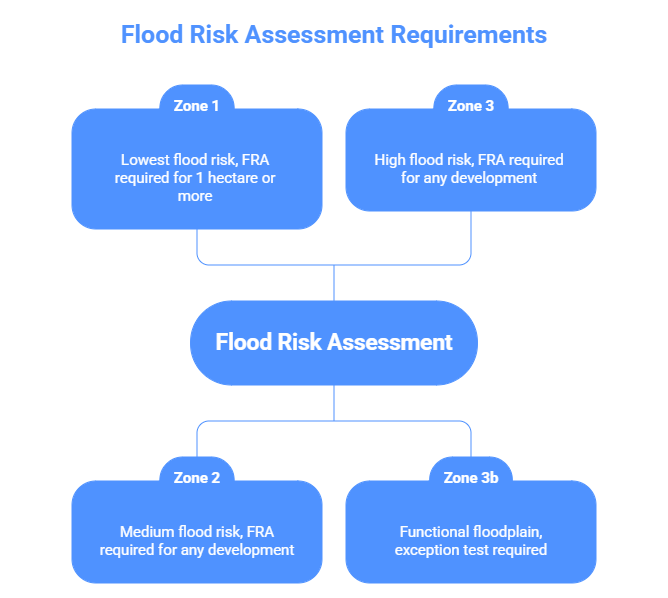
The main factor that decides whether you need a flood risk assessment is the site’s flood zone. The Environment Agency classifies land in England into Flood Zones 1, 2 and 3. Zone 1 has the lowest probability of flooding and Zone 3 the highest. If your site is in Flood Zone 2 or 3, you must submit an FRA with your planning application.
For sites in Flood Zones 2 and 3, the planning authority may also require the sequential test for flood risk. This test shows that the development cannot reasonably be located on land at a lower risk of flooding, and it is often a critical step in securing planning permission.
Flood Zone 2: Any development proposed in this zone requires a flood risk assessment, regardless of site size. Flood Zone 2 is land with a medium probability of flooding: between a 0.1% and 1% annual chance of river flooding, or between 0.1% and 0.5% from the sea.
Flood Zone 3: This is land with a high probability of flooding: a 1% or greater annual chance of river flooding, or a 0.5% or greater annual chance of flooding from the sea. All development in Flood Zone 3 must be supported by an FRA and is subject to the strictest planning tests.
Flood Zone 3b: The functional floodplain is land where water has to flow or be stored during floods. It is defined by the local planning authority in its Strategic Flood Risk Assessment. Only water-compatible development and essential infrastructure are permitted here, and essential infrastructure must also pass the Exception Test. Housing and most other development is not permitted.
When Flood Zone 1 Requires an FRA
Most development in Flood Zone 1 does not need an FRA. An FRA is still required in Flood Zone 1 when:
- The site is 1 hectare or larger.
- The land has been identified by the Environment Agency as having critical drainage problems.
- The council’s Strategic Flood Risk Assessment shows the land will be at increased flood risk in future.
- The site is at risk from other sources, such as surface water or groundwater, and the development introduces a more vulnerable use, for example a change of use to housing.
Surface water flooding is the most common reason a Flood Zone 1 site still needs an assessment.
When Is a Proportionate FRA Enough?
Not every application needs a full, modelled flood risk assessment. The level of detail should match the scale of the development and the level of risk.
Minor development in Flood Zones 2 and 3, such as house extensions and small non-residential extensions under 250 m², still needs flood risk information. In most cases it can follow the Environment Agency’s flood risk standing advice rather than a detailed study.
A detailed FRA with flood modelling is usually needed for new dwellings, larger schemes, sites in Flood Zone 3, and sites where the Environment Agency holds no reliable flood levels.
Check Your Council’s Validation List
Each local planning authority publishes a local validation list. Some councils ask for flood information beyond the national triggers, especially in areas with known surface water or drainage problems.
Check it before you submit, because an application without the required information can be made invalid.
Consequences of ignoring an FRA
If a planning application does not include a flood risk assesment can result in serious consequences like refusal or delay.
- Refusal of Planning Permission: If the Local Planning Authorities (LPA) identify any lack of information or unsatisfactory data in your planning application, they can deny your application under planning policy terms.
- Appeals and Delays: Appeal in case of refusals to the Planning Inspectorate and the Secretary of State can take months. And it does not guarantee a decision overturn and is costly.
- Sequential and Exception Tests: In the case of development in a high-risk flood zone, the flood risk assessment can trigger a sequential test, and a sequential test can further trigger an exception test. Flood risk assessment is not just a policy; it is a protection for the people of England. So, ignoring FRA and its essential components not only affects your planning application but also puts your safety at risk.
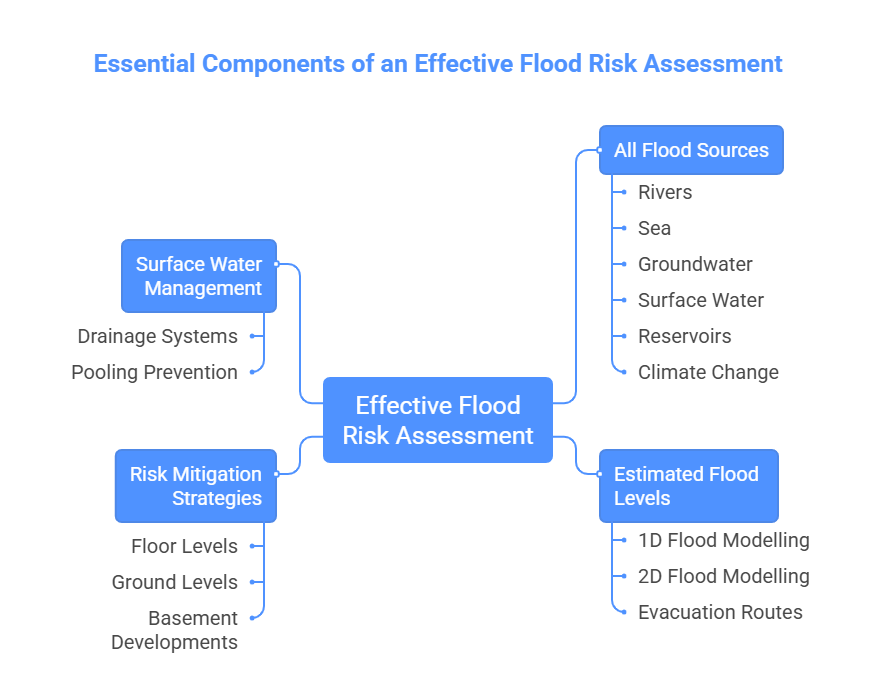
An effective flood risk assessment report must include:
All Flood Sources: A flood risk assessment includes flood probability data from rivers, the sea, groundwater, surface water, reservoirs, and climate change allowances. Flood risk assessment from all sources builds a strong foundation for planning permission and flood protection.
Estimated flood levels: Professionals, such as RIDA Reports, perform 1D and 2D flood modelling to predict flood levels, depth, and direction. Flood modelling also helps in pinpointing safe evacuation routes in the risk mitigation strategy section of an FRA.
Risk Mitigation Strategies: An effective flood risk assessment also includes flood risk mitigation strategies after analysing the flood risk of a site. It includes predicting floor and ground levels, skipping basement developments in high-risk zones, etc.
Surface Water Management (SuDS): If development faces surface water flood risk, the flood risk assessment report will also recommend surface water drainage systems to prevent pooling of heavy rainfall water and prevent it from turning into a flood.
Next Step If Your Site Needs an FRA
If your site falls within any of the triggers above, the assessment must be submitted with your planning application. See our Flood Risk Assessment for Planning service for what is included, fixed fees and turnaround times support your application through to approval.
Frequently Asked Questions
In England, the two main statutory consultees on flood risk are the Environment Agency (EA) and the Lead Local Flood Authority (LLFA). The EA advises on flood risk from rivers and the sea, mainly for development in Flood Zones 2 and 3. The LLFA advises on surface water flooding and drainage, mainly for major developments.
An inadequate submission can lead to additional costs, rework and deadlines being pushed forward. By providing a complete FRA from the beginning, you can avoid planning refusals and ensure that the development stays safe throughout its course.
Yes. Minor developments, including house extensions, require a Flood Risk Assessment if they are located within Flood Zones 2, 3, or 3b. Even where the extension is under 250m², a simplified FRA is still necessary for household applications. Additionally, an FRA is mandatory in any location if the proposed works could affect a watercourse, culvert, or existing flood defence.
Conclusion
A flood risk assessment is required for development in Flood Zones 2 and 3, for sites of 1 hectare or more in Flood Zone 1, and for Flood Zone 1 sites affected by other sources of flooding or critical drainage problems. Minor developments can often use a proportionate assessment.
To commission an assessment for your application, see Flood Risk Assessment for Planning.