
Flood Risk Assessment: Clear Planning Conditions
A Flood Risk Assessment ( FRA) is a technical report required with planning applications in the UK for planning permission. A Flood Risk Assessment by RIDA Reports demonstrates that the development will be safe and will not increase the risk of flooding elsewhere as it is a general requirement by the Enviroment Agency and local flood risk management authorities.
Our experienced flood risk consultants prepare clear, policy-compliant FRAs that fulfil all planning conditions and clear all flood-related hazards.
Speak to RIDA Reports consultants if your site requires a Flood Risk Assessment. Our team will review and prepare an FRA specifically tailored for your site. We help developers, architects, homeowners and planning consultants on residential, commercial, and mixed-use development sites throughout England.

Flood Risk Assessment for Planning Permission
Planning permission is a formal approval you need to get in the UK to carry out any development. The rules and regulations differ slightly in each nation. For example, if we talk about England, the planning permission is operated under the Town and Country Planning Act 1990, and the National Planning Policy Framework (NPPF) guides it.
For planning permission, you need to submit an application. Now, if your development is proposed in a high-risk flood zone or faces flood risk due to surface water or drainage issues, you are required to submit an FRA with your planning application for approval.
A Flood Risk Assessment is a technical report that:
- Assess all sources of flood
- Identifies the flood hazards
- Proposes mitigation strategies
- Proves the development is not increasing the risk of flooding elsewhere
NPPF and accompanying guidance consider flood risk very seriously for developments and require the development to be either:
- Directed to the lowest flood risk zone
- assessed, safe and mitigation measures have been taken
Our Clients






When is a Flood Risk Assessment mandatory?
The requirement for a Flood Risk Assessment depends on your site’s location, the scale, vulnerability and local evidence. Different resources can be used to check whether your development needs an FRA:
- Flood Map for Planning
- Check for long-term flood risk
- RoFSW map
- Critical drainage issues
- History of the site
Flood Risk Assessment is also known as a Flood Risk Report, and both refer to the same technical submission. If you are unsure whether your development needs an FRA, you can contact RIDA Report consultants for expert guidance.
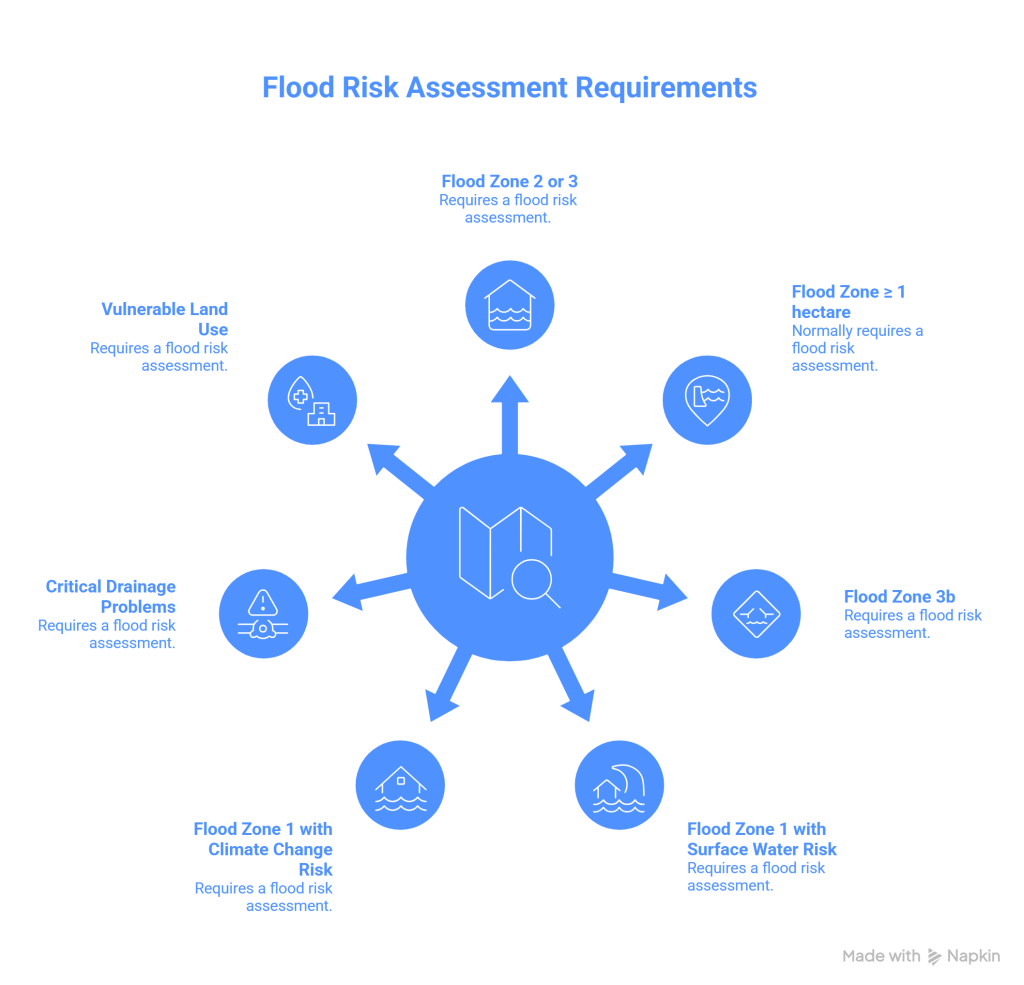
Typical triggers for Flood Risk Assessment
Flood Zone 2 or 3 | A Flood Risk Assessment is required |
Flood zone ≥ 1 hectare | A Flood Risk Assessment is normally required |
Flood Zone 3b ( Functional floodplain) | A Flood Risk Assessment is required |
Flood zone 1 with surface water flood risk | A Flood Risk Assessment is required |
Flood zone 1 is at risk of flooding in future due to climate change | A Flood Risk Assessment is required |
Areas with critical drainage problems | A Flood Risk Assessment is required |
development introduces more vulnerable uses (e.g. housing, hospitals) | A Flood Risk Assessment t is required |
If you do not submit an FRA with your application when it is a requirement, then the local planning authority will most likely refuse the application. Always check the planning conditions of your sites to make informed decisions.
Planning Conditions that require Flood Risk Assessment
Sometimes, planning permissions are granted with conditions, typically requiring a Flood Risk Assessment. For example, a common planning condition might state “ no development shall commence until a site-specific Flood Risk Assessment has been submitted to and approved by the LPA”
These conditions often occur at sites where initial feasibility suggests flood risk might be an issue, but the exact mitigation is not yet known. In such cases, a professional Flood Risk Assessment is the right tool to address these conditions and provide the right and justified mitigation measures.
This is why it is always wise for developers to engage with RIDA Reports early in the process and address all flood-related conditions, so if a condition like this appears in a decision or pre-application advice, everything is ready and covered.
What an FRA for Planning needs to cover
The final output of the Flood Risk Assessment should be s complaint and structured report, and it must cover:
- Flood source analysis and identify all relevant flood sources. The flood sources typically include rivers, the sea, surface water, groundwater, reservoirs, sewers, canals, etc. Their probability and extent at the site are also assessed.
- Flood zone is confirmed ( 1,23) using the official flood maps
- Climate change is included, and appropriate allowances are applied, specifying the guidance to account for future conditions.
- Development layout and mitigation designs are included, and also show how the site layout will avoid or mitigate flood risk.
- Demonstrate that the development will not increase the risk of flooding elsewhere.
- Address emergency access, evacuation routes and emergency plans.
In some cases, the development must demonstrate compliance with certain policy tests, such as the Sequential test and the Exception test. If required, the FRA might also have to include drainage strategies like SuDS.RIDA Reports prepare sequential and exception tests where required and also provide drainage strategies.
How Flood Risk Influences Planning Decisions
Flood risk is an important consideration in planning. This means your development proposal can be refused if flood risk is not properly addressed. When an LPA reviews an application, they
- Check if the FRA complies with policy (NPPF and PPG)
- Consult the Environment Agency or the Lead Local Flood Authority when needed
- Apply the sequential test and exception test where required.
If there are issues, they may refuse the application, but often they first request additional strategies, such as better drainage plans or revised mitigation strategies.
RIDA Reports provide a well-written FRA that helps the planning officer and consultants understand the site’s flood profile. Our reports prevent planning delays or refusals by addressing everything proactively.
Our approach to a compliant Flood Risk Assessment
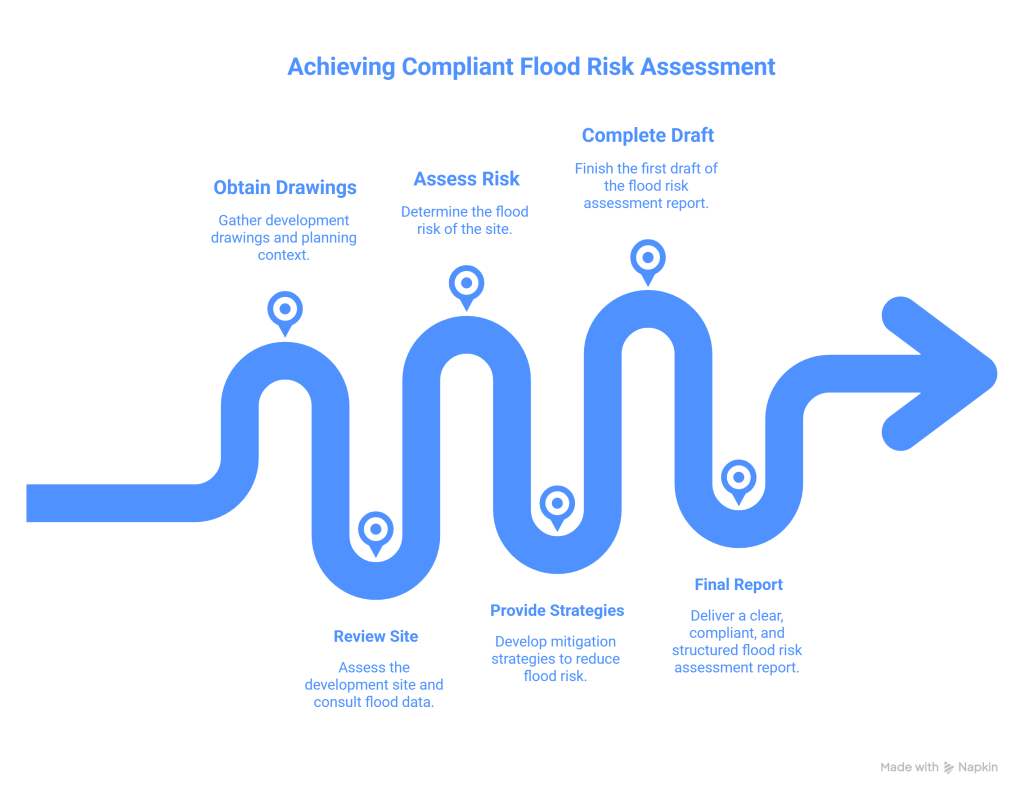
RIDA Reports prepare flood assessment reports using a structured approach. Our methodology typically consists of:
- Obtaining your development’s drawings and planning context.
- We review the development site. Consult official data sources, such as flood maps and flood data. Assess the flood risk of your site.
- Provide mitigation strategies
- The first draft is completed in 48 hours.
The result is a clear, compliant and structured Flood Risk Assessment report. O ur civil and structural engineers ensure robust solutions and strengthen our planning approval while following the Environment Agency’s standing advice for Flood Risk Assessments.
Related Flood Risk & Drainage Services
Often, other technical submissions are also required alongside a Flood Risk Assessment . RIDA also offers:
- Sequential and Exception Test: These tests report for developments in higher-risk zones (required by the NPPF) and show that a sequential low-risk site search has been done or that any flood risk is outweighed by benefits.
- Flood Modelling Services: We provide hydraulic modelling for complex sites where detailed river modelling is required to understand flood levels and depths.
- Surface Water Drainage Strategies and SuDS design: To demonstrate that site runoff will be managed sustainably,y and critical drainage issues have been addressed and taken care of.
We can coordinate these services, so your planning application has all the necessary flood and drainage evidence in one go.
Why developers, planners and homeowners choose RIDA Reports
Flood risks can delay or prevent planning approval if not addressed properly.RIDA Reports perform planning-focused Flood Risk Assessments and provide you with compliant flood reports that authorities expect.
Our clients trust us because
- We are reliable and fast with a 48-hour turnaround for many FRAs.
- Our team has chartered flood risk engineers and consultants with over 21+ years of experience.
- Our services a re comprehensive as we handle and deliver everything: data collection, 1D and 2D modelling, report writing and even Sequential/Exception Test preparation when required.
- We design clear, concise and practical reports ready for planning submission.
- We follow an integrated approach and coordinate with required documents like SuDS strategies and the design team.
We help our clients clear planning conditions and submit a policy compliant with the FRA!
A Flood Risk Assessment for planning is important in England for residential, commercial, and mixed-use developments. Hiring a specialist at an early stage of your development can help you address flood risks and receive a complaint FRA report perfect for your planning application.