
Flood Risk Assessment Flood Zone 2
Flood Risk Assessment Flood Zone 2 is a critical requirement for any proposed development within the moderate risk flood area. If your site falls within flood zone 2, you will typically have to submit an FRA for planning permission.
A site-specific flood risk assessment report should demonstrate that all flood risks have been assessed and the site is safe for development following the proposed mitigation strategies. Your Local Planning Authority might as well request a sequential test to move developments to the lowest flood risk area.
RIDA Reports provide full planning support required for development in Flood Zone 2. Our services also include sequential tests to demonstrate that the lowest risk has been considered, prove no appropriate low-risk site is available, and the proposed site is the most appropriate option, alongside a detailed, planning-compliant Flood Risk Assessment for your project.
Our methodology is based on national policy guidance and requirements. Our reports are accurate, compliant and aligned with what local authorities expect. We support our clients through the planning process with expertise and experience of 21+ years.

What are Flood Zones?
Flood zones are the first thing people check for when buying, selling or developing land in England. They are available on the Environment Agency Flood Map for Planning. This map has divided the land of England into three flood zones based on flood risk, with flood zone 1 having the lowest risk, flood zone 2 having moderate flood risk and flood zone 3 having the highest flood risk.
- Flood Zone 1: In England, this zone has less than a 0.1% annual probability of flooding from rivers and the sea. Development is usually safe and allowed here, but certain planning conditions can mandate an FRA, as explained in our guide Flood Risk Assessment Flood Zone 1.
- Flood Zone 2: In England, this zone has a moderate risk of flooding. This zone has 0.1%-1% annual probability of river flooding or 0.1%-0.5% annual probability of sea flooding. Development is allowed in flood zone 2, but with serious considerations. The planning authorities will consider the type of development, flood risk assessment and effect on neighbouring areas before giving planning permission.
- Flood Zone 3:In England, this zone has the highest risk of flooding, with ≥ 1% annual probability of river flooding or ≥ 0.5% annual probability of coastal flooding. This zone is divided into two sub-categories: flood zone 3a and 3b. Development in this zone is heavily restricted and controlled.
Our Clients






When is an FRA Required in Flood Zone 2
In Flood Zone 2, a Flood Risk Assessment is always required. Government guidance states that all development applications in flood zone 2 must be accompanied by an FRA. This includes new houses, flats, commercial buildings, extensions and even a change of use.
Flood Zone 2 has no lower size threshold or use of exception, unlike Flood Zone 1. In simple words, if your project is in Flood Zone 2 and needs planning permission, plan on preparing an FRA.
Key points:
- All projects in Flood Zone 2 trigger a flood risk assessment. You may face refusal if you submit your planning application without an FRA in flood zone 2.
- Your Local Planning Authorities can introduce additional requirements for a development proposed in flood zone 2 based on strategies, flood risk assessments and local plans that may flag future flood risks.
- Flood Zone 2 has no FRA exemption, unlike Flood Zone 1. This means you should not expect an FRA exemption if your development in Flood Zone 2 is small
If your development is in Flood Zone 2, it is wise to assume an FRA will be needed for planning permission. You can contact our flood risk consultants to discuss your project or even request a flood risk appraisal to figure out what you need for planning permission in England.
Sequential and Exception Tests in Flood Zone 2
Planning in Flood Zone 2 can also trigger the UK Sequential test and possibly the exception test before planning permission can be granted. These tests are required by the National Planning Policy Framework to steer development to the lowest risk area.
Sequential Test
This test is done to direct new developments towards areas with lower flood risk. In this test, all reasonably available sites are identified and compared with the flood risk of the current site. This test follows a sequential method; the first priority is always Flood Zone 1, and then the site moves to Flood Zone 2 and then Flood Zone 3.
If a lower-risk site is found during the test, then in terms of Flood Zone 2, the development continues in Flood Zone 2. This test is done to show the local planning authorities that lower-risk sites have been properly considered and no reasonable sites were available.
Kindly note that not all developments in Flood Zone 2 need the sequential test. Developments such as small shoulder extensions, conservatories, non-domestic extensions with a footprint under 250 m² and sites with only surface water flood risk often do not require a sequential test.
Any larger or more vulnerable development in Flood Zone 2 normally triggers the sequential tests. The sequential test can be performed before an FRA or separately alongside an FRA.
Exception test
If the sequential test is satisfied, the next step is to check if the exception test applies. For Flood Zone 2, the exception test is only required for very vulnerable uses. The NPPF classifies “highly vulnerable” developments (basement homes, permanent residential caravans/mobile homes, and emergency centres ) as needing an exception test in Flood Zone 2. The normal houses and commercial buildings come under “ more vulnerable” development in Flood Zone 2 and do not require an Exception test.
When an exception test is needed, it has two parts:
- The test demonstrates that the development provides sustainability and community benefits that outweigh the flood risk
- The site can be made safe throughout its life through proper mitigation measures.
As these tests are applied during the planning stage, it is best to speak with your LPA as soon as possible about the sequential and exception tests.
RIDA Reports Sequential and Exception Tests
RIDA Reports offers expert support for these tests and FRA. We can prepare sequential tests and, if required, exception test documentations to satisfy the planning authorities. The benefits of hiring us:
- We systematically assess and compare your development against different sites
- Our rapid turnout reduces the time and costs that are often associated with delaying planning applications
- We use the latest data on flooding through official and verified sources
- We offer fixed pricing.
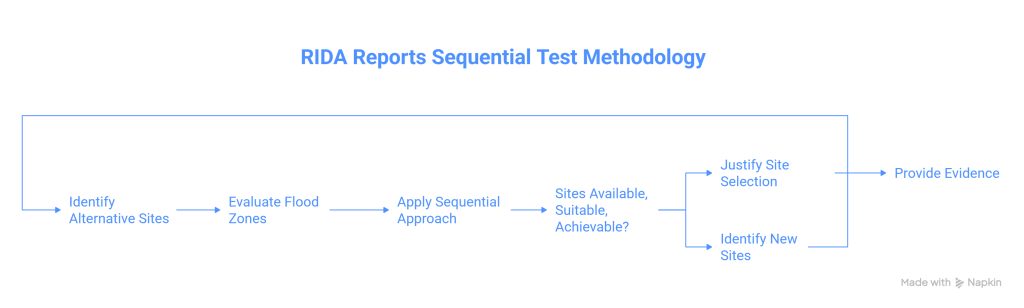
Our methodology for the sequential test:
We identify alternative sites for testing. This is done by reviewing the council’s policy documents and planning approach. We also determine the baseline parameters for comparable sites
We evaluate flood zones of all sites and also assess all flood sources
Apply a sequential approach and prioritise sites in lower flood risk.
Consider whether the sites are available, suitable and achievable for the proposed developments.
We then move to justifying the site selection and provide clear evidence of why the lower risk sites are not reasonably available and why the proposed site is appropriate.
Need support with your Sequential Test?
We at RIDA Reports offer planning support through sequential tests, exception tests, flood risk assessment and many other flood risk services.
Contact our flood risk consultants today and get your no-obligation free quote!
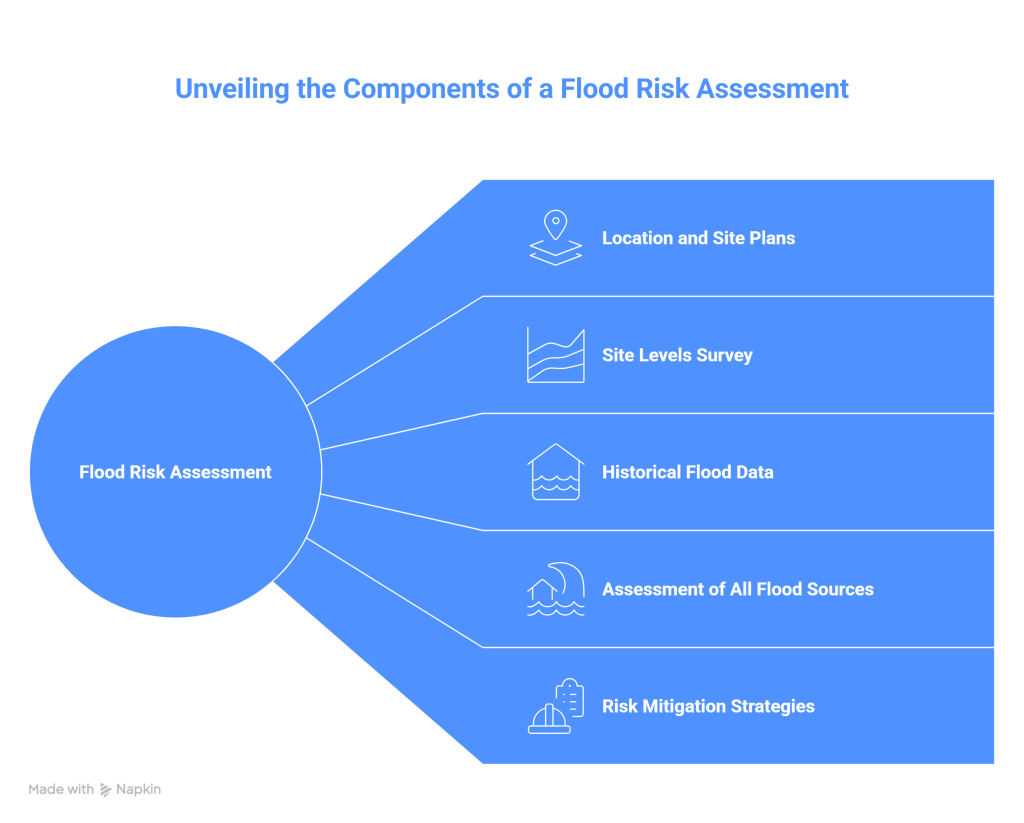
What must be included in a Flood Risk Assessment (FRA)
A flood risk assessment has to satisfy all requirements of national planning authorities. Government guidance recommends using the Environment Agency’s FRA template as a beginning point.
Our flood risk reports include all the points required by the planning authorities for planning permission. Our reports include:
- Location and Site Plans: Our reports include a location plan that shows your street name, nearby rivers/streams/ponds and landmarks and a detailed site plan. The site plan includes information about the existing land, such as the proposed development layout, any structure than can affect water flow, etc.
- Site Levels Survey: We perform site surveys during the flood risk assessment and include the height of the ground across your site, the general overall height of the site, the height of roads around the site and the height of the lowest inetrnal floor in your building to show it will be above flood water.
- Historical Flood Data: Details on any known past flooding. This also includes the recorded flood extents, reports on prior floods, and internal drainage board information. If available, we also add information on how the flood affected the site.
- Assessment of All Flood Sources: Our reports consider every relevant flood source and include information about how the sources can affect the site and how risk may change due to climate change. Every flood source’s likelihood, depth, speed and hazard level will be included.
- Risk Mitigation Strategies: Our flood risk assessment reports include mitigation strategies that clearly demonstrate how the development will be kept safe and how the development will not increase the risk of flooding elsewhere.
Ready to proceed with your flood risk assessment?
RIDA Reports provides a Flood Risk Assessment that will cover all required topics. Our reports help planners, developers, industry experts and homeowners assess flood risk comprehensively and design a complaint planning application. Contact us today to discuss your project details and receive expert guidance.
Why choose RIDA Reports for Flood Risk Assessment
RIDA Reports offer flood risk assessment, sequential and exception test and drainage strategy services for residential, commercial, industrial and strategic development sites across England. We have been providing planning support for 21+ years, and our clients trust us for our expertise in curating planning-ready flood risk reports.
Our reports meet the local and national planning policies, are cost effective, enable our clients in making informed decisions and protect your developments against flood for a lifetime. We also help you understand planning requirements, and only opt for a flood risk assessment when it is required.
Our reports are professionally structured to align with planning requirements set out by the UK Government and Local Planning Authorities. Each report ensures all relevant flood risk and planning considerations are addressed, making it straightforward for planning officers to review and validate the submission.
Speak to our Flood Risk Consultant today!
If you want a flood risk assessment for your development, or expert guidance in figuring out whether an FR is best for you or a Flood Risk Assessment, you can contact us today to discuss your project and receive professional guidance.