The UK’s National Flood Risk Assessment predicts that by the end of 2065, properties in flood will double in number. The flood does not just damage properties, it also causes health problems, life endangerment, and it’s dirty.
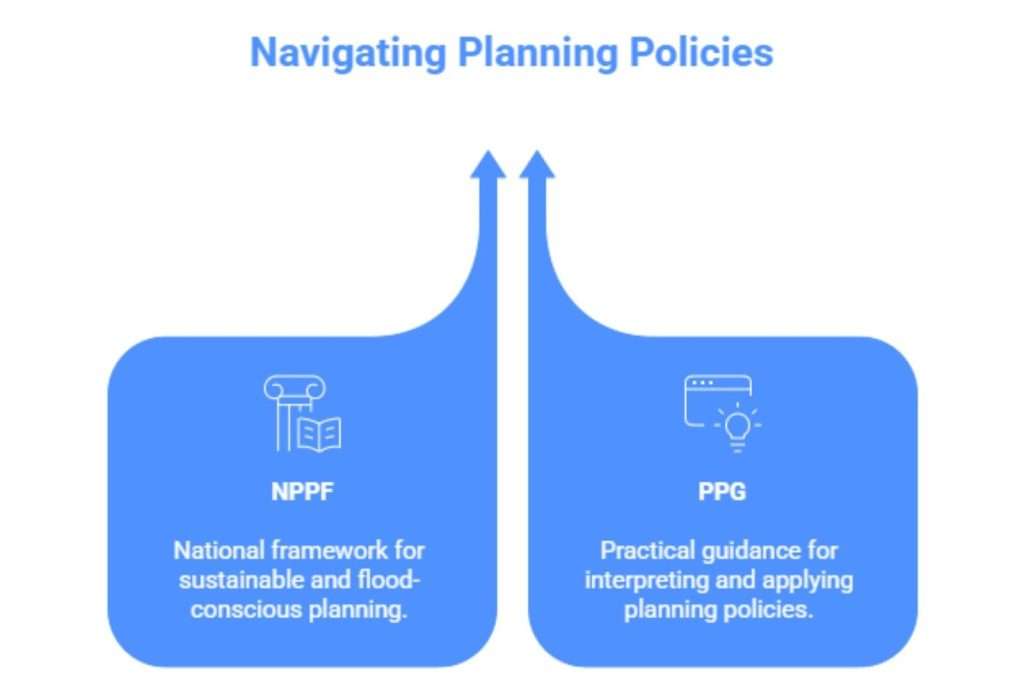
To prevent flooding and flood damage in the UK, the government has created the National Planning Policy Framework (NPPF) and its companion document, Planning Practice Guidance (PPG). The NPPF acts as a national policy, and the PPG acts as a practical guide on how to apply this planning policy.
It is important for homeowners, architects, developers, and local authorities to understand these documents and implement them during planning permission applications and development. Let us take a closer look at the PPG and its recent policy update in September 2025.
What is Planning Practice Guidance
Basically, the government of England has created an official document called the National Planning Policy Framework (NPPF). A policy rulebook that plays a key role in the planning system, especially when flood risk and coastal changes are involved. It advises all local planning authorities and developers on what can and can not be done during planning. This document is yet non-statutory (not enshrined in law), but it is extremely important for all kinds of developments, such as houses, buildings, roads and etc. NPPF contains:
Organised chapters.
It is published in the form of a framework document.
Updated less frequently and through formal consolidated versions.
A sustainable approach is used for designing NPPF, so it is environmentally, socially, and economically beneficial.
This document is used to cross-check check planning permission application.
This document provides guidelines for climate change, flood risk and mitigation.
To understand this document and learn how to interpret it, the government created the planning practice guidance for flood risks. An online document consisting of topic pages, for example, “Flood risk and coastal change”. PPG contains
A planning checklist to confirm every flood risk assessment report covers everything before submission.
What flood sources should be considered during an FRA?
Guidelines on how to perform an exception and a sequential test.
Examples to help in the interpretation of NFFP.
Updated regularly, topic by topic.
PPG plays a key role in helping developers and consultants prepare everything according to the planning policy document. Both NFFP and PPG are available on the government website.
Planning Practice Guidance Recent Update: Flood Risk and Coastal Change
We mentioned earlier that PPG is published on the government website, topic-by-topic and page numbers. So on 27th September, 2025, the page “Flood Risk and Coastal Change” was updated.
The government revised paragraphs 23, 27, and 28 of the guidance and introduced a new paragraph 27a. Let us take a detailed look at this update :
All Flood Sources Included
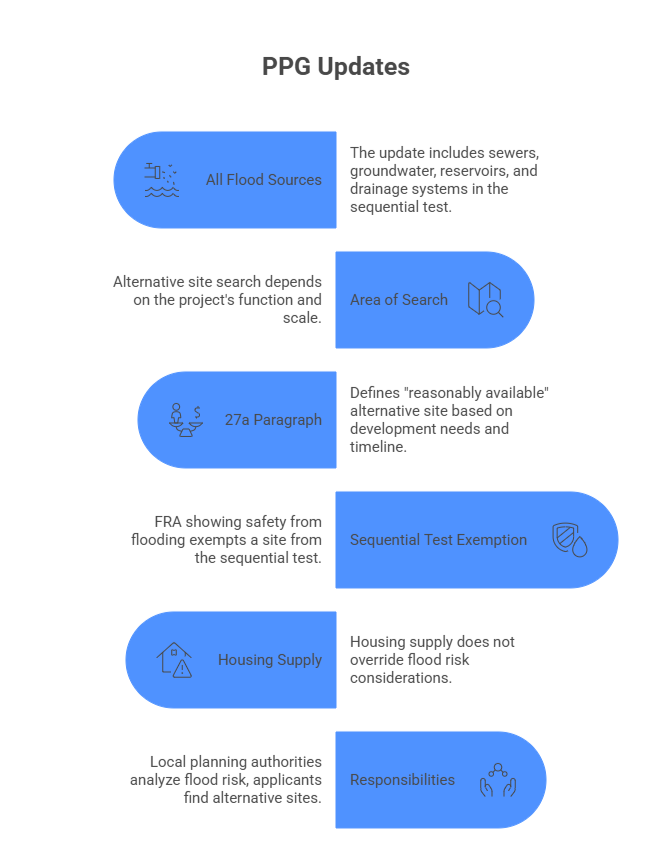
The new update clearly states that all flood sources will be considered for a sequential test. The sequential test now will consider not just rivers and the sea, but sewers, groundwater, reservoirs and drainage systems.
Area of Search
The 27th updated paragraph sets rules for alternative area search. It states that the area of search for an alternative site will depend on the function and scale of the project. For example, you are planning to build a small house in a village, so you stay within the boundaries of the village, and do not explore for an alternative site any further.
27a Paragraph
The new 27a paragraph defines the definition of “reasonably available” alternative site. This paragraph states that a site will only be considered for an alternative site if it meets the development needs of the project. The alternative site should be suitable and able to be developed within the project’s timeline. This update also clarifies that ownership of the alternative site does not matter; the applicant does not have to be its owner. Two or more small, different sites can be combined to meet the project’s needs.
Sequential Test Exemption
The updated guidance has made the FRA exemption clearer. It states that if the flood risk assessment of an area shows a site will be safe from present and future surface water flood through safety design and mitigation without increasing the risk of flood elsewhere, then a sequential test is not necessary for planning permission.
Housing supply does not override flood risk
In the updated paragraph 25, the government make it extremely clear that no one is allowed to bypass flood tests to meet housing supply. In simple words, planning authorities are not allowed to use the lack of housing as a relevant consideration in applying the sequential test. Whether the demand for housing is low or high, an FRA and a sequential test have to be performed, and the lowest flood risk sites should be considered first.
Planners and developers’ responsibilities
The updated paragraph 28 emphasises the responsibilities of the local planning authority and the applicants. It states that it is the local planning authority’s job to look for an appropriate area and analyse the flood risk assessment. On the other hand, it clarifies the role of applicants; they should work on looking for “reasonably available” alternative sites. The new updated paragraph also encourages the LPAs to carry a register of potential sites based on flood risk.
The flood risk and coastal change section of the planning practice guidance plays a key role in planning permission. The PPG and NPPF work alongside to make the implementation of flood policy possible. In simple words, PPG can guide on how to manage flood hazards at each stage of planning.
For example, if there is a new development in a high-risk flood zone, then an applicant has to attach a flood risk assessment report with their planning application for consideration and approval. The PPG also gives a step-by-step guide on how to go through a new development. For instance, the first step you have to do is find the lowest risk zone. After completing analysis and making sure there is no low-risk zone available, only then do you move to a higher-risk zone. The PPG even provides a step-by-step flowchart (image 2) to ease the entire process.
Rule For Sequential and Exception Test
The guidance explains how to apply sequential and exception tests. The basic rule of a sequential test is to always go for low flood risk zones first. If a low-risk zone is not available for development, only then can you move to a higher-risk zone. And for high-risk zones, developers and planners need to perform an exception test to make sure development is safe in this zone with proper mitigation strategies.
Role of Sustainable Drainage Systems (SuDS)
PPG also tells about sustainable drainage systems, which are installed or built in areas prone to rainwater. The SuDS works similarly to a normal drainage system, and it slows down the rainwater flow through built-in features and nature-based solutions. Guidance also emphasises designing a SuDS at the beginning of the project. All developers should learn how to build SuDS and how to maintain it. Rida reports has 21+ years of experience in designing effective sustainable drainage systems , which not only protects from flood but also protects the environment.
Higher Consultations
Planning guidance reminds the planning authorities to consult a flood field expert agency during the permission and development process. For example, if a development is under consideration in zone 2 or 3, then it is necessary for the LPA to do a formal consultation with the Environment Agency. If the Environment Agency advises against a project, the local planning authority has to go through a referral(call-in) procedure to approve their project.
By following the PPG, homeowners and developers know exactly what studies, tests and design measures are needed to meet national policy.
Guides for Planning Practice Guidance
Town and Country Planning Association is a local organisation that simplest the rules of practice planning guide. It is not related to the government, and it has one goal for locals to understand what NFFP and PPG are saying. These local guides also explain how documents like PPG play a key role in flood risk prevention and damage protection.
The National Flood Risk Assessment (NaFRA) is a UK‑wide analysis that maps and quantifies flood risk from rivers and the sea, helping government and planners understand where flooding is most likely and which communities are most at risk.
NaFRA data supports strategic decision‑making by national and local authorities, informing investment in flood defences, planning policies, and how flood risk is managed in local plans and infrastructure projects.
NaFRA doesn’t forecast specific weather events but provides long‑term, probability‑based estimates of flood risk under current climate conditions, offering a consistent baseline for planning and risk management.
Conclusion
Planning practice guidance is a manual for the National Policy Planning Framework, and it plays a key role in understanding planning policies in England. Guidance was last updated on 7th September 2025, and it can further evolve with time. It is also important to only hire agencies for flood risk assessment and planning permission help who closely stay updated with national policies such as RIDA reports.