
Flood Risk Report vs Flood Risk Assessment
Flood Risk Reports and Flood Risk Assessments are two types of reports with very similar sounding titles; however, they are two distinct types of reports in the U.K. property, conveyancing and planning systems.
Although both relate to the issue of flooding and may utilize similar data sets or mapping, they were created for two entirely different uses, created for two totally different audiences and utilized at two completely different times throughout the process of buying/selling a property or developing land.
Therefore, selecting the wrong type of report could create many problems. In addition to creating unnecessary expense, the use of an incorrect report can confuse parties involved in the transaction process and delay the process until further information is received.
The purpose of this guide is to clarify the difference between a Flood Risk Report and a Flood Risk Assessment, which report was developed for whom, and what is the appropriate time to obtain each report. By understanding these differences you will be able to select the correct type of report at the correct time, minimizing the potential for delays in your property transaction and achieving a smooth and successful outcome.
What is the Difference Between a Flood Risk Report and a Flood Risk Assessment?
The difference in terms of purpose, target audience and usage for a Flood Risk Report and a Flood Risk Assessment (FRA), can be significant.
The primary use of a Flood Risk Report is for residential property transactions, i.e., when you are purchasing or selling your home. Therefore, a Flood Risk Report is usually commissioned by conveyancers acting on behalf of either the seller or buyer to enable them to understand what flood risk means specifically for that particular property. In essence, its primary function is to clarify and reassure the parties involved with regard to the environmental search results and flood map indications regarding the potential flood risk associated with the subject property.
On the other hand, a Flood Risk Assessment (FRA) is a technical report designed to support a planning application to the Local Planning Authority when a property owner submits a planning application for a new development or extension, which may involve works affecting land adjacent to or downstream from the proposed site. It addresses the issue of whether it is safe to undertake the proposed development based upon existing flood risk, and also whether the development would exacerbate flood risk in the surrounding area.
While both forms of assessments do provide information about the flood risk, they will generally be answering different questions and therefore cannot be substituted for each other.
Flood Risk Report (Conveyancing)
A Flood Risk Report is normally commissioned by a solicitor or conveyancer by a buyer or seller who has concerns regarding potential flood risks which may impact upon their ability to buy/sell, insure, obtain a mortgage etc.
The reports will identify the flood risk and explain what that means in terms of how you can own/purchase a property
Common users include:
- Buyers and homeowners
- Solicitors and conveyancers
- Insurers and mortgage lenders
Typical use cases:
- Residential purchases
- Remortgaging
- Responding to conveyancing enquiries
The emphasis is on interpretation, not engineering design.
Flood Risk Assessment (FRA)
An FRA is a technical document prepared in order to provide information to support a developer’s application to a local authority as part of the development control process for sites which have either been identified as potentially at risk from flooding or will change the drainage characteristics of the site.
The FRA assesses both the impact that a proposed development could have on its potential to be flooded and the potential impact that a proposed development may have on flood risk elsewhere.
Common users include:
- Developers and architects
- Local planning authorities
- Councils and statutory consultees
Typical use cases:
- New development
- Change of use
- Extensions in flood-sensitive areas
FRAs often include modelling, calculations, and mitigation proposals to satisfy planning policy.
Key differences explained: Flood Risk Report vs Flood Risk Assessment
Both Flood Risk Reports and Flood Risk Assessments (FRA’s) have a connection to flooding but are produced to meet different requirements at different points in time in the buying and selling process. FRA reports can be used to help with the sale of a property, while FRAs are primarily used to support planning applications. The information contained within the table below sets out the main differences between Flood Risk Report and Flood Risk Assessment reports.
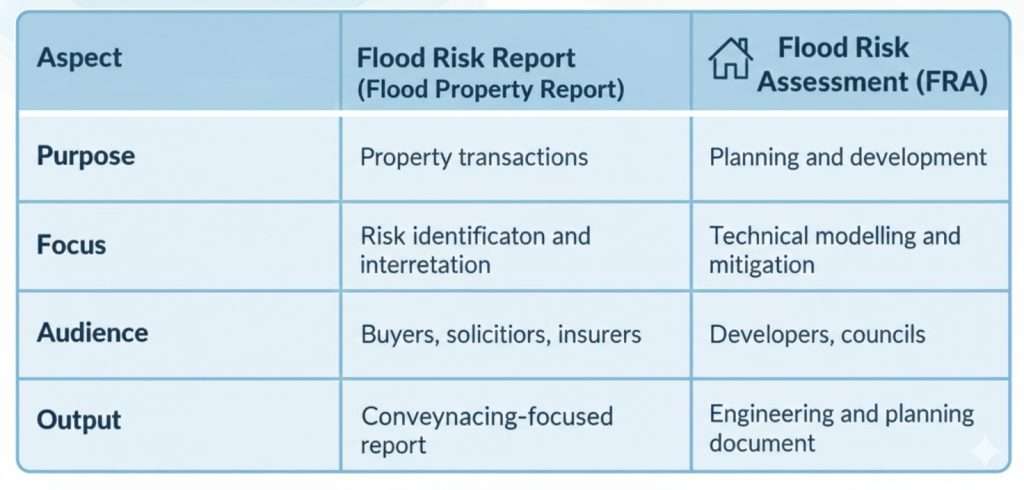
Understanding these distinctions is essential when determining which report is required.
Why Choosing the Correct Report Matters
There are several common issues that can arise when the wrong type of flood report is selected, particularly because a Flood Risk Report and a Flood Risk Assessment (FRA) are produced for different purposes and audiences.
The incorrect report can lead to confusion, increased workloads for solicitors or planners and ultimately delay the process.
Possible problems include:
- Solicitors declining a planning FRA for use in conveyancing: In property transactions, solicitors and their clients require a clear, property specific explanation of flood risk and its implications in practice. The planning FRA is generally technical in nature and is focused upon compliance with planning regulations rather than ownership or transactional risk. In addition, the planning FRA will likely lack the clarity necessary to address standard conveyancing questions.
- Planning Authorities decline a flood risk report: Planning Authorities will generally require a formal FRA for applications involving developments to which flood risk policy applies. Flood Risk Reports are typically prepared for other purposes than meeting planning validation requirements, and may not have the technical data, flood mitigation measures, or planning focused format that would be acceptable to the Authority for the purpose of determining whether the development should proceed.
- Additional expense resulting from having to obtain a second report: The majority of cases resulting from selecting the wrong report will involve a second, suitable report being commissioned, and therefore, an increase in total costs. This expense can be eliminated by identifying the report needed at the outset.
- Delays to transactions, or decisions relating to planning applications: When flood risks are identified and the wrong report is submitted, it is possible that the submission will trigger delays prior to obtaining the required documentation, raising further queries or escalating the matter to the lender, insurer, or planner.
A Flood Risk Report is unable to replace a planning FRA, whereas an FRA is usually too complex and costly for the purposes of property transfer.
Practical Guidance
As a general rule, the correct report depends on what you are trying to achieve.
- Buying or selling a home → Flood Risk Report
This is the best way to provide information in relation to supporting the sale/purchase of a property and answering buyer’s questions. - Mortgage, insurance, or conveyancing enquiries → Flood Risk Report
A Flood Risk Report is designed to assist lenders, insurers and solicitors in understanding the flood risk clearly and consistently. - Planning application or development → Flood Risk Assessment (FRA)
If you are submitting a planning application or undertaking development which will trigger policy requirements regarding flooding, an FRA is usually the correct documentation.
It is recommended that if you are unsure of which report you require, seek professional guidance prior to ordering the report. It reduces the likelihood of additional cost, delay or refusal to accept the report.
Conclusion
Flood Risk Report vs Flood Risk Assessment highlights how Flood Risk Reports and Flood Risk Assessments have been identified as two separate and distinct elements of the UK property systems process. While both types of reports deal with flooding, there are significant differences between them in terms of objective, audience and output.
Choosing which type of report to complete at the beginning of the process will help prevent delays, unnecessary costs, and confusion and ensure that the flood risk is assessed appropriately for the decision being made.
Frequently Asked Questions
A Flood Risk Report is typically utilized for real estate transactions such as purchasing, selling, or insuring a house.
An FRA is a technical document that is submitted as part of a planning application to assess the potential impacts of a proposed development on flooding or the impacts of the development on increasing flood risk elsewhere
No. A Flood Risk Report does not meet planning requirements. Local Planning Authorities require a Flood Risk Assessment where planning policy states one is necessary, particularly in Flood Zones 2 and 3 or for certain types of development.
No. For buying or selling an existing property, a Flood Risk Report is normally sufficient. A FRA is generally required for new construction projects, or for properties being modified for a change of use.
Yes. An FRA is typically more technical and detail oriented than a Flood Risk Report and will include a site specific assessment and engineering evaluation. A Flood Risk Report is more focused on interpretation and practical implications for ownership or transactions.
Although unlikely, there are some circumstances under which you may need to complete an FRA even though your property is located within a Flood Zone 1 area. These include:
- Certain types of developments
- Properties of a certain size
- Surface water flooding in areas that have been identified as having this type of flooding problem
Your local authority will provide guidance regarding whether an FRA is required for your development.