
Flood Risk When Selling a House
Flood risk when selling a house is becoming a more common issue for sellers in the UK, as buyers increasingly raise concerns during property purchases. Where a property has never previously flooded, it is now routinely investigated as part of the standard conveyancing process through environmental searches and flood mapping due to increased awareness of flooding, driven by climate change, updated modelling and scrutiny from lenders and insurers.
The greater the uncertainty sellers face regarding the disclosure of flood information during a transaction, the greater the possibility that a sale will be delayed, fall through or remain undecided.
This guide provides information on whether a seller must disclose flood risk when selling a house, how flood risk can affect a sale and how sellers can use flood risk report to provide clear, transparent answers to buyer enquiries.
Should you disclose flood risk when selling a property?
Yes. In the UK, sellers are required to disclose relevant and material information about a property, including known flood risk or any history of flooding.
This includes:
- Past flooding affecting the property
- Known flood events in the immediate area
- Information provided by previous surveys or reports
The failure to disclose a material fact of flood risk may lead to litigation issues, delays in a transaction process, or even potential claims for damages at the conclusion of a transaction. Although no flooding has taken place, an identified flood risk associated with the subject property based on reports or past inquiries may still require honest disclosure.
How flood risk affects property sales
Flood risk can influence several aspects of a property transaction, even if no flooding has occurred.
Common impacts include:
Buyer confidence
Potential homebuyers may have a lack of knowledge about how flood risk will affect them. Therefore, they could become wary of making an offer, or at least cautious in their decision-making. In addition, buyers may make assumptions regarding the risks associated with purchasing a property and therefore reduce their offer..
Property valuation
The surveyor who assesses the value of the property may also consider the flood risk as well as whether there are any measures to mitigate this risk (i.e., whether insurance for the property is available) when determining the value of the property.
Mortgage approval
Typically lenders require confirmation from the seller of the property that it has been properly insured. If there is uncertainty as to what the potential flood risks are, or how insurance will be available for the property, then lenders may delay issuing a mortgage offer.
Negotiation outcomes
If the buyer feels that the flood risk has been identified by the seller, but that the seller has not adequately explained this issue, the buyer may request a reduction in the price of the property. Alternatively, the buyer may ask the seller to provide further assessments of the flood risk or ask the seller to include contractual provisions to address the flood risk issue.
Flood risk when selling a house in the UK: managing buyer concerns
Modern buyers increasingly conduct their own due diligence using environmental searches and publicly available flood maps. These tools often rely on broad modelling assumptions that do not always reflect the real-world risk to an individual property.
Additionally search results from such tools may identify potential flood risk to a buyer as they relate to the distance between a property and local water courses, or the result of surface water modelling. Both buyers and sellers alike can be alarmed by these findings unless correctly interpreted.
Taking a proactive approach to flood risk helps to:
- Build buyer confidence
- Demonstrate transparency
- Reduce the risk of last-minute delays
- Keep the transaction moving forward
Providing clear, evidence-based explanations early in the process is far more effective than reacting defensively once concerns are raised.
For a general overview of the selling process, sellers can refer to the UK government’s guidance on selling a home, alongside more specific considerations such as flood risk. As well as practical advice from Citizens Advice.
Using a flood risk report in conveyancing
Flood risk when selling a house can be effectively managed with a professional flood risk report, which is an invaluable tool during the conveyancing process.
A well-prepared report can:
- Provide clarity for buyers and solicitors
- Reduce uncertainty during pre-contract enquiries
- Support transparent and consistent communication
- Help avoid unnecessary delays or renegotiation
A property’s flood risk can be quantified using various flood maps and databases which identify properties that lie within designated flood areas or zones. However, such maps are often based on generalised models and do not take into account specific local factors that may affect the likelihood of flooding at individual locations.
The role of the Flood Property Report (FPR)
The Flood Property Report (FPR) framework is designed to assess whether flood risk is likely to affect:
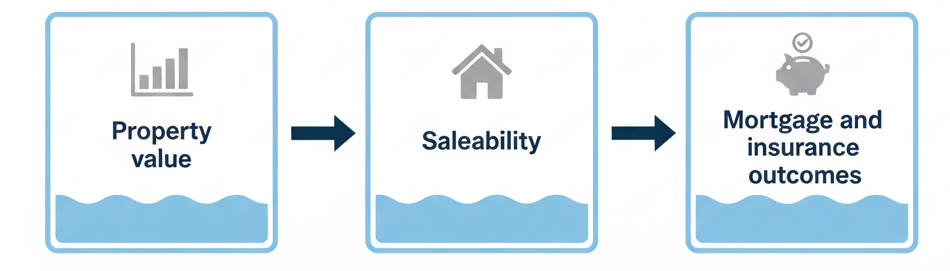
Flood Property Reports provide a detailed, property-specific explanation of flood exposure based on technical analysis of flood data and mapping. This information, when presented in a property-specific report format, can assist both the seller and buyer in understanding the potential risks associated with a given property.
By translating flood risk into clear implications for ownership and transaction risk, FPR supports more efficient and transparent property sales.
Practical tips for sellers
- Review flood risk early, before marketing the property
- Be transparent when responding to conveyancing enquiries
- Avoid relying solely on generic flood maps
- Use a professional flood risk report to support explanations
This early clarification of a potential issue can help avoid disputes arising from misunderstandings of the flood risk at a later stage and therefore reduce the likelihood of last minute issues arising.
Conclusion
Flood risk when selling a house is an increasingly common and growing concern for buyers and sellers in the UK. The existence of flood risk does not necessarily mean you cannot sell your property, but it can create uncertainty and therefore make some potential buyers feel less confident about purchasing your home and it may also cause delays in the transaction process.
A professional flood risk assessment will allow you to identify risks before they become a problem, as well as giving you the ability to communicate this clearly to potential buyers. This demonstrates whether flood risk will have a practical effect on the value or saleability of your property.
Frequently Asked Questions
Yes. Although your property may have never actually flooded, the fact that a search, survey or report indicates there is a risk of flooding may well be material to a purchaser and should be disclosed as such.
No. While a high degree of certainty can be unsettling to both buyers and sellers, most properties which have some level of flood risk will sell. It's typically not the presence of flood risk that creates problems, but rather the lack of clarity as to what that means to a particular property.
Yes. In extreme cases, when a purchaser discovers flood risk late in the purchase process, and that risk was inadequately explained by the seller, the purchaser may feel that their faith in the transaction has been lost and withdraw from the purchase process or attempt to negotiate better terms on the sale price.
Yes, this would generally be recommended if there is an expectation that a flood risk search will indicate a flood risk. This way you can prepare for any questions that may be asked during the sales process.
While a flood map provides a general outline of flood risk, it does not normally provide sufficient detail to allow a purchaser to understand how flood risk relates to their specific property. Publicly available tools, such as the UK government’s flood map for planning service, can offer a useful starting point, but they rely on broad modelling assumptions. An interpretive flood risk report will normally provide more meaningful information for the purchaser than a flood map alone.