
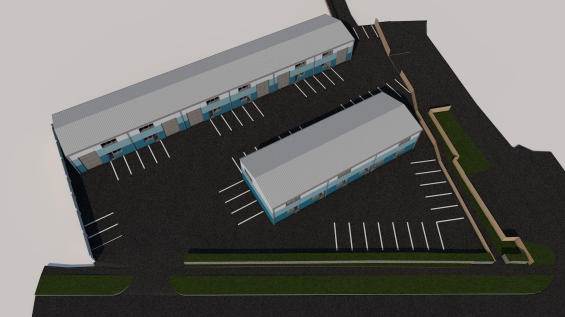
Questmap Business Park
The Brief
RIDA Reports was appointed to undertake a detailed flood risk assessment for the proposed Questmap Business Park, located near the South West Coast Path in Penzance. The project involves the construction of two new commercial buildings comprising nine industrial units, spanning a total area of approximately 3,500 square metres over an existing materials storage yard. Classified as a ‘Less vulnerable’ development, the site required a comprehensive assessment to ensure its safety over an estimated 20 to 50-year design life.
Why the Client Chose RIDA
With the site situated in an area constrained by multiple sources of flooding and strict local drainage policies, the client required specialist expertise to navigate the planning process. RIDA was chosen to provide the robust technical evidence and practical mitigation measures needed to demonstrate flood risk compliance, safely manage water runoff, and support the commercial viability of the proposed business park.
The Challenge
The site presented a complex set of environmental constraints. Primarily, it is located within Environment Agency Flood Zone 3, indicating a high probability of tidal flooding from the nearby English Channel. Furthermore, the development falls within a designated Critical Drainage Area (CDA). This designation means the local authority strictly requires any new development to actively reduce downstream flood risks, rather than merely having a neutral impact. Additionally, the site faces a medium risk of surface water flooding and a high risk of groundwater emergence.
The RIDA Difference
RIDA conducted a detailed flood risk assessment in strict accordance with the National Planning Policy Framework (NPPF) and the Cornwall Council Preliminary Flood Risk Assessment. Using the sequential risk-based approach, RIDA established that as a ‘Less vulnerable’ commercial use, the development was appropriate for the area and the Exception Test was not required.
To address the high tidal flood risk, RIDA assumed a precautionary water depth of 0.6m and developed a resilience strategy based on a ‘water exclusion’ approach for the lowest 300mm. Mitigation measures included specifying suspended concrete floor slabs at least 150mm thick, sealing foundation blocks with impermeable materials, and positioning all critical services—such as electrical wiring, gas meters, and heating systems—above the predicted flood level. To tackle the high groundwater risk, threshold levels were raised by a minimum of 150mm, exceedance flow paths were designed around the buildings, and a tanking membrane was proposed up to 200mm above ground level. Finally, to satisfy the strict CDA requirements, RIDA outlined a Sustainable Drainage Systems (SuDS) strategy incorporating infiltration devices and permeable surfaces to manage surface water runoff and reduce downstream impacts.
The Outcome
The detailed assessment successfully demonstrated that the new industrial units could be developed safely for their design life without increasing flood risk elsewhere. By detailing tailored flood resilience measures and a compliant surface water management strategy, the report provided the robust technical evidence necessary to satisfy local planning policies and the Environment Agency. To finalise the safety framework, RIDA also recommended the implementation of a formal Flood Warning and Emergency Response Plan for future occupants.