
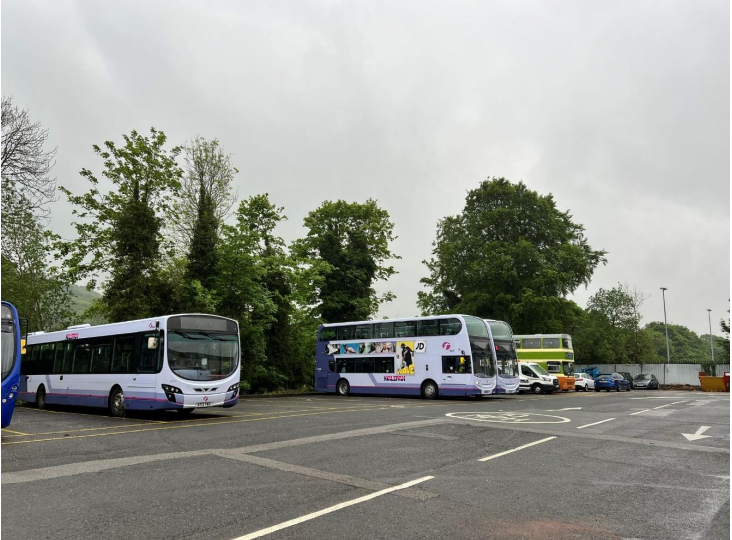
Elmwood Garage, Huddersfield Road, Halifax
The Brief
RIDA Reports was appointed to undertake a detailed flood risk assessment for a proposed commercial infrastructure development at Elmwood Garage, located on Huddersfield Road in Halifax. The project entails the installation of a new external electrical infrastructure unit (RMU) positioned on a level concrete plinth within an existing bus depot. Classified as a ‘Less Vulnerable’ development with an estimated operational lifetime of 50 to 100 years, a comprehensive evaluation was required to ensure the long-term safety and resilience of the new infrastructure.
Why the Client Chose RIDA
The proposed infrastructure required robust technical documentation to satisfy local planning requirements and demonstrate sustainable water management. The client engaged RIDA for our proven expertise in delivering compliant, site-specific drainage strategies and our ability to navigate the stringent planning policies associated with developments situated within designated Critical Drainage Areas.
The Challenge
While the development footprint is safely located within Flood Zone 1—indicating a very low risk of fluvial or tidal flooding from the nearby Hebble Brook—the primary constraint identified during the assessment was surface water management. The site is situated within a local Critical Drainage Area (ACDP). Consequently, local planning policy dictated that the new development could not merely have a neutral impact on surface water runoff; it was strictly required to actively reduce downstream flood risks and incorporate a Sustainable Drainage System (SuDS) strategy, despite the modest footprint of the new installation.
The RIDA Difference
We conducted a detailed flood risk assessment in strict accordance with the National Planning Policy Framework (NPPF). By applying a sequential risk-based approach, we confirmed that the infrastructure was appropriately located in a low-risk zone, entirely avoiding the need for an Exception Test. To address the stringent surface water requirements of the Critical Drainage Area, we developed a targeted SuDS strategy. Recognising the freely draining nature of the site’s topsoil, we outlined a drainage methodology utilising infiltration techniques to manage and attenuate runoff sustainably without increasing discharge rates. Furthermore, to protect the electrical infrastructure from any residual ground-level water, we incorporated the design mitigation of raising the unit onto a level concrete plinth.
The Outcome
The assessment successfully demonstrated that the proposed electrical infrastructure would remain safe and operational over its design life while actively managing surface water to prevent exacerbating risks elsewhere. By detailing a sustainable drainage strategy perfectly tailored to a Critical Drainage Area, the comprehensive report provided the robust technical evidence required to confidently support the client’s planning application.