
Drainage Specialist Cost: What Determines Fees in 2026
A plain guide to what drives drainage specialist cost, from site surveys to SuDS strategies, and when you actually need one.
Drainage specialist cost depends on the service required and the scale of the project, not on a fixed market rate. A simple extension may only need a short, proportionate flood risk assessment, while major development requires a fuller sustainable drainage strategy and consultation with the Lead Local Flood Authority (LLFA). This article explains what drives fees for site surveys, SuDS strategies and detailed drainage design, and when a consultant is genuinely needed.
Key Technical Takeaways
- Drainage specialist cost varies by the service required and project scale rather than following a single fixed fee.
- Minor householder development, such as extensions and garages, generally only needs a shorter, proportionate flood risk assessment.
- Major development, defined by unit numbers or site area, requires fuller SuDS reporting and Lead Local Flood Authority (LLFA) consultation.
- Detailed drainage design costs rise where infiltration is not viable, since controlling runoff to the 1% annual exceedance probability standard typically needs infiltration testing and modelling.
- A planning authority may refuse an application if a satisfactory flood risk assessment is missing, so cost should be weighed against the risk of refusal.
What Does a Drainage Specialist Actually Do?
A drainage specialist, also called a drainage consultant, is the person a developer pays to assess flood risk and design how a site will manage surface water, so that a planning application meets the Environment Agency’s and local planning authority’s requirements. The Environment Agency advises that applicants will usually need to pay a flood risk specialist to carry out a flood risk assessment, with an exception possibly being a simple, low-risk development such as a house extension, which an applicant may be able to do themselves. Where there is doubt, the Environment Agency recommends contacting it directly for advice.
In practice the work spans several linked tasks: Checking the Environment Agency’s flood map for planning to establish surface water flood risk and designing a Sustainable Drainage System in line with the National standards for sustainable drainage systems are both part of the flood risk assessment process for planning applications.
- Site survey work, including topographic survey and mapping of existing drainage
- Flood risk assessment against the Environment Agency’s flood map for planning
- SuDS strategy or detailed drainage design in accordance with the National standards for sustainable drainage systems
- For major development, the local planning authority must consult the Lead Local Flood Authority on surface water drainage
Typical Drainage Specialist Costs in 2026
There is no single fee for drainage consultancy because the findings do not set out fixed prices; cost depends on the service required and the scale of the project. A simple householder extension may only need a short, proportionate flood risk assessment, while a scheme classed as major development will need a fuller sustainable drainage strategy and ongoing liaison with the Lead Local Flood Authority. Fees should be understood as reflecting this range of work rather than as a single market rate.
Three broad categories of instruction are common: a standalone site drainage survey, a SuDS strategy report submitted with or within a flood risk assessment, and a full detailed drainage design for major development. Each carries different data, modelling and consultation requirements, which is the main driver of fee differences between projects.
Site Drainage Survey Costs
A site drainage survey establishes existing conditions: how the site currently drains, what infrastructure is already present, and whether the site falls within Flood Zones 2 or 3, Flood Zone 3b, or an area with critical drainage problems, any of which triggers a requirement for a flood risk assessment. For minor householder development such as extensions, sheds, garages and games rooms, a pragmatic, shorter and simpler assessment is generally sufficient, which keeps survey scope proportionate.
Larger or more complex sites increase survey scope because more information is needed to satisfy the nine questions a sustainable drainage strategy submission must address, covering existing drainage arrangements, existing runoff rates and volumes, and proposed management of surface water. Sites near a main river may also need checks for a flood risk activity permit, required within 8 metres of a riverbank, flood defence structure or culvert for non-tidal main rivers, or 16 metres for tidal main rivers.
SuDS Strategy and Drainage Design Fees
A sustainable drainage strategy can be submitted as a separate document or as part of a flood risk assessment, and applicants must submit one with proportionate information as part of their planning application, including outline applications, having regard to the nature and scale of the development. This proportionality is why fees scale with project size rather than following a flat rate.
Detailed drainage design costs rise where the drainage hierarchy points away from simple infiltration. Where a site is discharging to a surface water body, sewer or piped system, the design must control runoff rate and volume for the 1% annual exceedance probability event so the development does not increase flood risk elsewhere, and must also prevent flooding on any part of the site for a 1 in 30 year event and in any building, including a basement, for a 1 in 100 year event. Meeting these standards typically requires infiltration testing and modelling, which adds to design fees.
The National standards for sustainable drainage systems state: “the surface water runoff (rate and volume) for the 1% annual exceedance probability (AEP) event shall be controlled to ensure the runoff from the development does not increase flood risk elsewhere.”
Why Drainage Consultant Fees Vary by Site
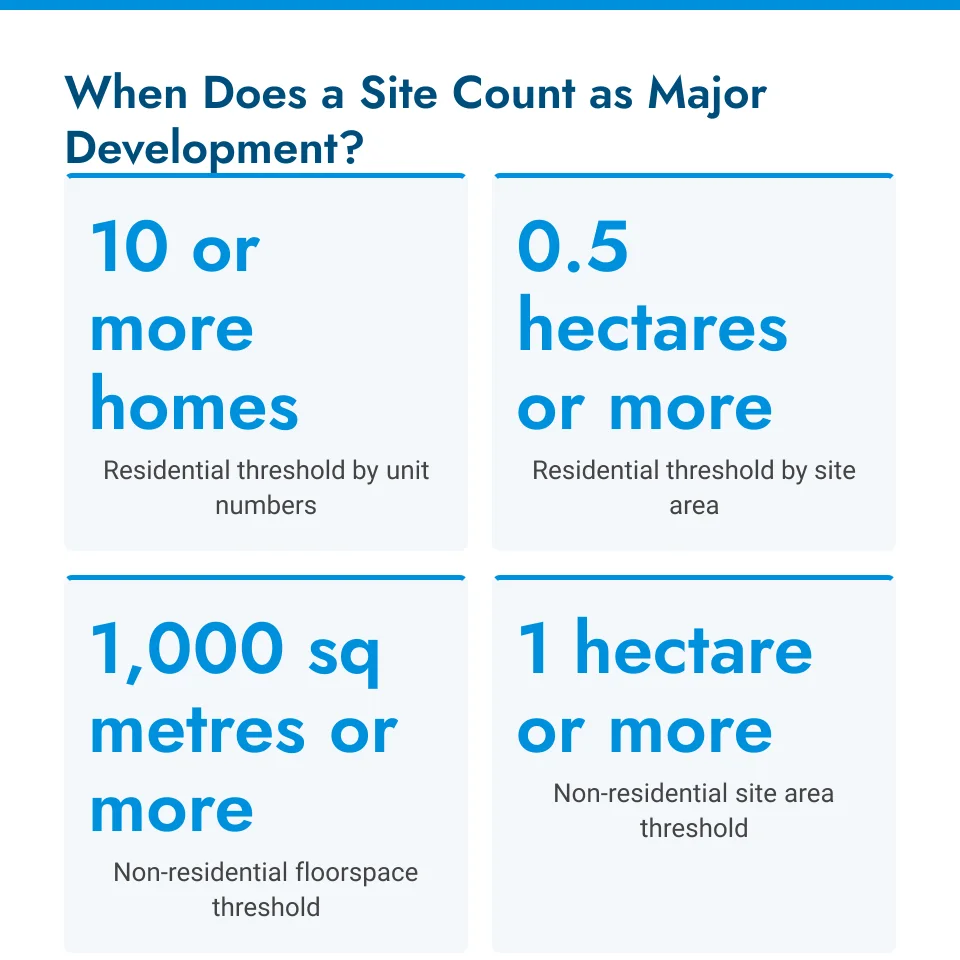
Fee variation largely follows how the planning system classifies a site and its flood risk, not simply its physical size. A development is classed as major where, for housing, 10 or more homes will be provided or the site is 0.5 hectares or more, and for non-residential development, where there is 1,000 square metres or more of additional floorspace or a site of 1 hectare or more. For major development with surface water drainage, the local planning authority must consult the Lead Local Flood Authority, and SuDS must have minimum operational standards and maintenance arrangements for the development’s lifetime, both of which add consultant input.
| Cost driver | Effect on fees |
|---|---|
| Location in Flood Zone 2, 3 or 3b, or critical drainage area | Flood risk assessment required for all development, including minor development |
| Proximity to a main river (within 8m or 16m for tidal) | May require a separate flood risk activity permit alongside planning permission |
| Site in a coalfield area | Pre-application consultation with the Coal Authority and site-specific assessment needed |
| Scale meeting the major development threshold | LLFA consultation and fuller SuDS strategy required |
Important: A planning authority may refuse an application if a satisfactory flood risk assessment is not included where one is required, so cost should be weighed against the risk of refusal, not treated as an optional extra to trim.
Do You Need a Drainage Survey for Planning Permission?
In most cases, yes. The Environment Agency’s flood map for planning must be checked as part of any planning application to establish whether a site is at risk of surface water flooding, now or in future. A flood risk assessment is required for all development, including minor works and changes of use, proposed in Flood Zones 2 or 3, within Flood Zone 3b, or in areas with critical drainage problems.
Where sustainable drainage is proposed, it must be designed in accordance with the National standards for sustainable drainage systems, and a sustainable drainage strategy must be submitted as part of the planning application, either as a standalone document or within the flood risk assessment itself.
Your local planning authority may refuse your application if you do not include a flood risk assessment or if it is not satisfactory.
Important: Not including a required flood risk assessment, or submitting one that is not satisfactory, is a stated ground for refusal. The drainage survey is not a formality; it is a condition of a valid, approvable application.
Local planning authorities must also consult their Lead Local Flood Authority on surface water drainage for major development, and the Environment Agency recommends similar consultation for other developments in flood-risk areas.
Cost for a Small Development or Single House Extension
The Environment Agency advises that you will usually need to pay a flood risk specialist to carry out a flood risk assessment, but notes an exception may apply for a simple, low-risk development such as a house extension, which an applicant may be able to complete themselves. If you are unsure whether your project qualifies, the advice is to contact the Environment Agency directly before assuming you can self-assess.
Minor development for flood risk purposes includes householder projects such as extensions, sheds, garages and games rooms, and minor non-residential extensions up to 250 square metres of floorspace. Even these are still required to meet site-specific flood risk assessment requirements, though a pragmatic, shorter and simpler assessment is likely to be sufficient in most cases.
| Project type | Assessment likely needed | Who may complete it |
|---|---|---|
| House extension, simple and low-risk | Short, proportionate FRA | Possibly the applicant, if confirmed with the Environment Agency |
| Minor non-residential extension (under 250 sq m) | Site-specific FRA, pragmatic scope | Usually a flood risk specialist |
| Development in Flood Zone 2, 3 or 3b | Full FRA required | A paid flood risk specialist |
At minimum, a minor development assessment must show the development will be safe for its users for its intended lifetime, without increasing flood risk elsewhere, and that it is sufficiently flood resistant and resilient. This narrower scope is what keeps fees proportionate for small projects compared with a full SuDS strategy.
Is Hiring a Drainage Consultant Worth the Cost?
The fee for a drainage consultant has to be weighed against the consequences of getting the assessment wrong. A local planning authority may refuse an application outright if a satisfactory flood risk assessment is not included where one is required, which can mean lost time, resubmission costs and delayed build programmes.
DevelopersMajor schemes
For development of 10 or more homes, or sites of 0.5 hectares or more, the Lead Local Flood Authority must be consulted on drainage arrangements, and SuDS need minimum operational and maintenance standards for the development’s lifetime.
Self-buildersExtensions
A simple extension may qualify for self-assessment, but confirming this with the Environment Agency first avoids submitting an FRA that is later judged unsatisfactory.
Non-residential developersChange of use
Minor non-residential extensions and changes of use still require a site-specific assessment, even where the scheme feels too small to warrant one.
Beyond planning risk, a flood risk activity permit may also be needed where a site sits within 8 metres of a riverbank, flood defence or culvert, or 16 metres for tidal main rivers, and developers in coalfield areas must consult the Coal Authority separately. A consultant’s fee typically covers identifying these additional obligations before they cause delay at a later stage.
- Check the Environment Agency’s flood map for planning before scoping any assessment.
- Contact the Environment Agency if unsure whether a simple extension qualifies for self-assessment.
- For major development with surface water drainage, the local planning authority must consult the Lead Local Flood Authority on proposed drainage arrangements.
- Ask whether a flood risk activity permit applies in addition to planning permission.
How to Get an Accurate Quote
A fixed-fee quote is only as accurate as the information a consultant is given at enquiry stage. Because flood risk assessment and drainage strategy requirements scale with site location and development size, a consultant needs certain facts up front to scope the right level of work rather than quoting generically and risking under- or over-charging later.
The Environment Agency’s flood map for planning establishes whether a site sits in Flood Zone 2, 3 or 3b, or has critical drainage problems, which determines whether a flood risk assessment is required at all. Site area and unit numbers determine whether a scheme counts as major development, triggering Lead Local Flood Authority consultation and fuller SuDS reporting. Planning authority requirements, including any pre-application advice already received, also shape scope.
- Site location plan and red-line boundary
- Flood zone classification from the Environment Agency’s flood map for planning
- Proposed development size: number of units, floorspace, or site area in hectares
- Existing surface water drainage arrangements and known runoff rates, if available
- Any pre-application correspondence with the local planning authority or Lead Local Flood Authority
- Proximity to a main river, riverbank, flood defence or culvert
Important: Without this information a consultant can only give an indicative range. A local planning authority may refuse an application where a flood risk assessment is missing or unsatisfactory, so an accurately scoped quote protects against costly resubmission.
Get a Fixed-Fee Drainage Strategy Quote from RIDA
RIDA Reports provides flood risk assessments and sustainable drainage strategies for planning applications of all scales, from householder extensions to major development sites. Each quote is based on your site’s flood zone, drainage hierarchy position and the proportionate information your local planning authority expects, whether submitted as a standalone strategy or as part of a wider flood risk assessment.
Send us your site location, flood zone status and development size, and we will confirm a fixed fee before any work begins, with no surprises once the report is underway.
- Share your site plan and red-line boundary
- Confirm the flood zone from the Environment Agency’s flood map for planning
- Tell us your proposed unit numbers or floorspace
- Request a fixed-fee quote tailored to your site
How much is a drainage specialist?
There is no single fee because cost depends on the service required and the scale of the project. A simple householder extension may only need a short, proportionate flood risk assessment, while major development needs a fuller sustainable drainage strategy and ongoing Lead Local Flood Authority liaison.
What does a drainage consultant charge for a SuDS strategy?
Fees scale with the nature and scale of the development because a sustainable drainage strategy must contain proportionate information, whether submitted standalone or within a flood risk assessment. Costs rise further where infiltration is not viable, since controlling runoff to the 1% annual exceedance probability standard typically requires infiltration testing and modelling.
Do I need a drainage survey for planning permission and how much does it cost?
In most cases yes: the Environment Agency’s flood map for planning must be checked for every application, and a flood risk assessment is required for all development, including minor works, in Flood Zones 2 or 3, Flood Zone 3b, or areas with critical drainage problems. Cost depends on whether a pragmatic, shorter assessment suffices for minor development or a fuller survey is needed for larger or more complex sites.
How much does a drainage report cost for a small development?
Minor development, including extensions, sheds, garages and games rooms, and minor non-residential extensions up to 250 square metres, still requires a site-specific flood risk assessment, but a pragmatic, shorter and simpler assessment is likely to be sufficient in most cases. This narrower scope is what keeps fees proportionate for small projects compared with a full SuDS strategy.
Is a drainage consultant worth the cost for a single house extension?
A simple, low-risk development such as a house extension is the exception the Environment Agency mentions where an applicant may be able to complete the assessment themselves, but it recommends contacting it directly if unsure. The fee has to be weighed against the risk that a local planning authority may refuse an application if a satisfactory flood risk assessment is not included where required.
Sources
Recommended sources
Get a Fixed-Fee SuDS and Drainage Strategy Quote
RIDA Reports scopes flood risk assessments and sustainable drainage strategies for sites of any scale, from extensions to major development, based on your flood zone and development size.
Request a Quote