
Annual Exceedance Probability (AEP)
Annual Exceedance Probability (AEP) represents the probability of a particular return period event occurring in any given year. AEP is used across all Flood Risk Assessments to categorise land and guide safe development. For the full technical definition, see the Environment Agency river modelling standards.
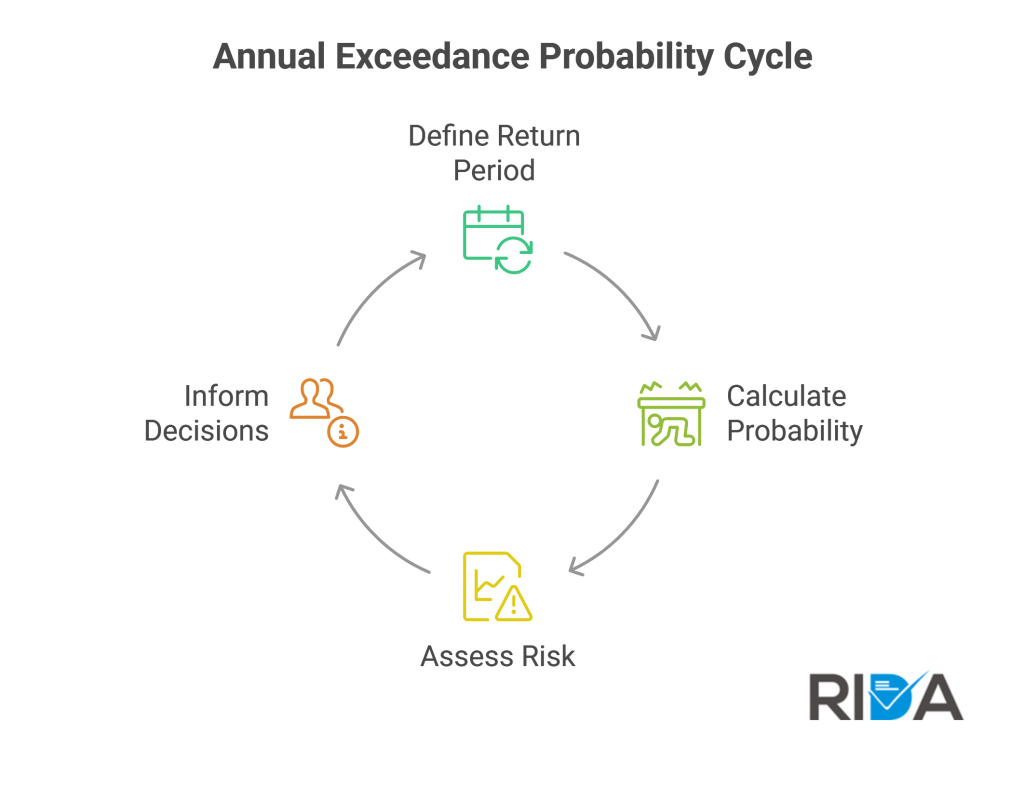
Annual Exceedance Probability (AEP) expresses the statistical likelihood of a flood event occurring in any given year. A 1% AEP flood has a 1 in 100 chance of happening each year — it does not mean it will only happen once every 100 years. The table below shows how AEP figures map to flood zones, return periods and risk levels used in UK planning policy.
| Flood Zone | Risk Level | AEP (%) | Return Period | Plain English Meaning | Planning Implication |
|---|---|---|---|---|---|
| Flood Zone 1 | Very Low Risk | Less than 0.1% AEP | Less than 1 in 1,000 year | Fewer than 1 in 1,000 chance of flooding in any given year | Most development acceptable. A Flood Risk Assessment is only required for sites over 1 hectare or where the SFRA flags a surface water issue. |
| Flood Zone 2 | Low Risk | 0.1% – 1% AEP | 1 in 1,000 to 1 in 100 year | Between a 1 in 1,000 and 1 in 100 chance of flooding in any given year | A Flood Risk Assessment is required for all development. The Sequential Test applies. Most uses are still permitted with appropriate mitigation. |
| Flood Zone 3a | Medium Risk | Greater than 1% AEP (rivers) Greater than 0.5% AEP (sea) | Greater than 1 in 100 year (rivers) Greater than 1 in 200 year (sea) | Greater than 1 in 100 chance of river flooding or 1 in 200 chance of sea flooding in any given year | A Flood Risk Assessment is required. Sequential Test and potentially the Exception Test apply. Highly vulnerable uses are not permitted. More vulnerable uses require the Exception Test. |
| Flood Zone 3b (Functional Floodplain) | High Risk | Greater than 5% AEP (or as defined by the SFRA) | Greater than 1 in 20 year (or as defined locally) | Land that floods or is designed to flood frequently. Water flows here naturally during storm events. | Only water-compatible uses (e.g. parks, nature reserves) and essential infrastructure (with Exception Test) are permitted. Residential and most commercial development is not allowed. |
Common AEP Examples Explained
| AEP | Return Period | Flood Zone | What it means in practice |
|---|---|---|---|
| 0.1% AEP | 1 in 1,000 year | Zone 1 / Zone 2 boundary | A 0.1% chance of flooding in any single year. This is the threshold between Zone 1 and Zone 2. |
| 0.5% AEP | 1 in 200 year | Zone 2 / Zone 3 (sea) | A 0.5% chance of tidal/sea flooding in any single year. The threshold for Zone 3 from the sea. |
| 1% AEP | 1 in 100 year | Zone 2 / Zone 3a (rivers) | A 1% chance of river flooding in any single year. The standard design event for most FRAs. The threshold for Zone 3a from rivers. |
| 3.3% AEP | 1 in 30 year | Zone 3a | A 3.3% chance of flooding per year. Used as an additional climate change check event in many FRAs alongside the 1% AEP. |
| 5% AEP | 1 in 20 year | Zone 3a / Zone 3b boundary | A 5% chance of flooding per year. Often used to define the functional floodplain (Zone 3b) threshold, though this can vary by SFRA. |
| 10% AEP | 1 in 10 year | Zone 3b | A 10% chance of flooding per year. Land at this probability is deep within the functional floodplain and is generally unsuitable for any built development. |
| 50% AEP | 1 in 2 year | Zone 3b | A 50% chance of flooding per year — this land floods more often than not. No built development is appropriate. Used in SuDS design to set discharge rates. |
Important: AEP over a building’s lifetime
A 1% AEP flood does not mean it will only happen once in 100 years. Over a typical 75-year mortgage period, a property in Flood Zone 3a has approximately a 53% chance of experiencing at least one 1% AEP flood event. Over the standard 100-year design life of a building, that probability rises to approximately 63%. This is why climate change allowances must be applied throughout the full design life of a development — not just at the time of construction.
Case Example
In Oxford, planners use AEP to categorise land into different Flood Zones, which then dictates what can be built there. By knowing the AEP, they can decide exactly how much higher to build a flood wall or how much extra “soakaway” space a new development needs.
Understand flood probability properly. Rida Reports applies AEP analysis within your Flood Risk Assessment.