

Understanding EA flood zones is important for anyone planning to develop a property in England. The Environmental Agency defines these flood zones based on the likelihood of flooding from different sources, such as rivers. Learning about a site’s EA flood zone is the first step in obtaining planning permission and deciding on flood risk assessment.
This guide will explain:
- What are EA flood zones?
- How to use the official Flood Map for Planning.
- Why these zones matter for development.
Environment Agency’s Role in Defining Flood Risk
The Environment Agency is a national organisation working to improve and protect the environment throughout England. In addition to managing flood risks, it also monitors climate change, protects wildlife, and oversees waste management.
Under the Flood and Water Management Act (2010), it works alongside side UK government and other agencies to deliver the national flood strategy, allocate flood funds, and provide flood risk data and advice.
The EA compiles flood zones across England as part of the national flood map for planning. The flood zones are updated regularly, and this year they were updated in the quarter of 2025. Local authorities consult the EA’s database when planning and reviewing applications that come under certain flood zones. The flood zone map is available on their website for public use
What are EA Flood Zones?
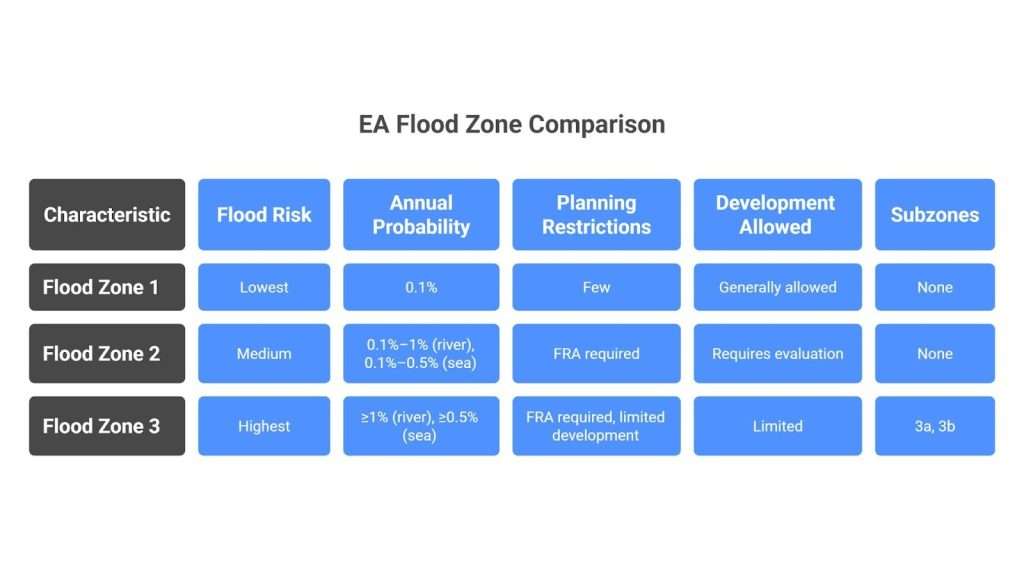
EA flood zones classify land by flood probability from rivers and the sea. The EA publishes these flood zones map online, and you can search by postcode, place name, or coordinates (easting/northing or grid reference). They do not account for flood protection defences when classifying land and focus only on major flood sources, unlike small streams, drainage ditches and etc. The earlier versions of the map also did not include future climate change impacts.
They use local models and past flood records to classify land into three categories:
Flood Zone 1 – The Lowest Risk
Flood zone 1 has <0.1% (1/1000) annual flood chance. This zone covers all land not placed in zones 2 and 3. Hence, it contains the largest area of England.
- It has a few planning restrictions; generally, you can build anything here
- If the selected development area is bigger than 1 hectare (1 ha), flood risk assessment must be carried out in zone 1.
- A surface water issue, like critical drainage, can also trigger an FRA.
Please note that this zone is not completely free from flood risks; a flood can be triggered from sources not noted by EA flood maps, like water drainage. It is best to plan for flood risk assessment in zone 1 to be fully sure about your site
Flood Zone 2 – Medium Risk
Flood zone 2 has a probability of 0.1%–1% annual chance of river flooding, or 0.1%–0.5% chance of sea/coastal flooding. It basically covers all land where flooding is possible but not frequent.
- Any development proposal in flood zone 2 requires an FRA. All proposals based in zone 2, even the smaller ones, require evaluation by flood specialists.
- The light blue area on the planning map is flood zone 2. It includes areas such as minor river floodplains or coastal areas that flood occasionally.
Flood Zone 3 – Highest Risk
Flood zone 3 is land with a 1% or greater annual chance of river flooding, or a 0.5% or greater annual chance of flooding from the sea. It is split into two parts. In Flood Zone 3a, development must pass the sequential test, and more vulnerable uses such as housing must also pass the Exception Test. Flood Zone 3b is the functional floodplain, where water has to flow or be stored in a flood. Only water-compatible uses and essential infrastructure are permitted there.
Accessing the Flood Map for Planning Service

The UK government provides the flood map for the planning service. This map is available on our website and is frequently updated. Key features of this service include:
- FRA requirement: The flood risk map shows all three flood zones. And if your area is based in flood zone 2 or 3, this means you require a flood risk assessment. This tool specifically tells you whether you need an FRA or not.
- Downloadable map: You can download and print this map from gov.uk ‘s website. The map shows flood zones, main rivers, the sea, and other features.
- Raw data: Consultants, developers, or even architects can request underlying flood risk data for detailed analysis.
- Other data layers: The flood map for planning also shows flood defences, main river designations, water storage areas, etc. You can even check climate change extents through the updated version of this service.
What Your Flood Zone Means for a Planning Application
Your flood zone is the starting point for deciding whether a planning application needs a flood risk assessment. Sites in Flood Zones 2 and 3 need one, and some Flood Zone 1 sites do too.
For the full list of triggers, see when a flood risk assessment is needed. If your site needs an assessment, see Flood Risk Assessment for Planning.
EA Standing Advice for Certain Developments
Minor development in Flood Zones 2 and 3, such as small extensions, can often follow the Environment Agency’s flood risk standing advice instead of a detailed assessment. See when a proportionate FRA is enough.
Limitations of EA Flood Zone Data
Although the EA flood zone map for planning is an indispensable tool, it still has some limitations. Let’s go through them one by one together:
- Static present-day view: The basic flood zone map only shows current risks, ignoring climate change. But fortunately, in 2025, the EA introduced a new layer into flood zones,” Flood Zones plus Climate Change”. This layer predicts how Zones 2/3 are expected to expand under future seniors.
- Ignores flood defences: The zone data completely ignores flood defences. Your property might be flood-protected, but the map will still treat your property as at risk if it is in zone 2 or 3.
- Excludes small water features: The flood risk data in this map is only based on the sea and rivers. Other sources, like groundwater, canals, or drainage, are not included. So there is a possibility, your property can flood even in zone 1, because of, say, local drainage failure.
- Data reliability: The EA itself states the data is “without any guarantees.” The map is based on data that can change and uncertain models. For better protection, opt for a flood risk assessment and protect yourself from all the hassle.
Going Beyond the Flood Zone Map
Because the flood zone map shows only river and sea flooding, without depths or defences, a site-specific assessment often needs more detail: flood levels, depths and velocities, surface water and groundwater risk, and the effect of defences and climate change. This is part of a Flood Risk Assessment for Planning.